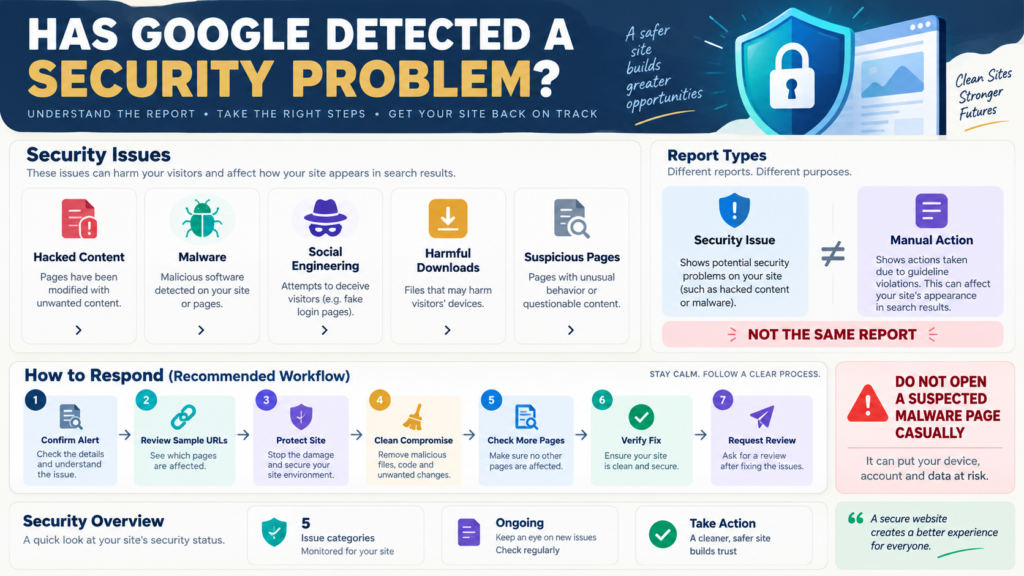
You log into Google Search Console and see a security warning.
That is very different from:
Average position declined.
Google’s Security Issues report is designed to report signs that a website has been hacked or contains behavior that could harm visitors.
Google currently lists issues such as:
- Hacked content.
- Malware or unwanted software.
- Social engineering.
- Harmful downloads.
- Other dangerous behavior.
Affected pages can receive warnings in Google Search, and browsers may display an interstitial warning before letting users visit the site.
This deserves attention.
But it is not the same thing as an ordinary SEO ranking problem.
Security Issues and Manual Actions Are Different
Google maintains separate reports.
Security Issues
Primarily identifies:
- Hacking.
- Malware.
- Phishing.
- Dangerous downloads.
- Social-engineering behavior.
Manual Actions
Primarily identifies violations of Google’s spam policies that may affect search visibility.
Google explicitly distinguishes the two reports.
Do not use the terms interchangeably.
What Happens When No Security Issue Exists?
Google says that if no security issue is currently detected, the report displays a green check and an appropriate no-issues message.
Google also notes that verified site owners can receive email notifications when a new security issue occurs.
That means you generally do not need to obsessively refresh the report every day.
What Is Hacked Content?
Hacked content is information placed on your website without permission after someone exploits a vulnerability.
Examples can include:
- Spam pages.
- Injected text.
- Unwanted links.
- Redirects.
- New URLs created by an attacker.
Google’s current Security Issues documentation includes hacked-content categories such as code injection, content injection, and URL injection.
Malware and Unwanted Software
Google may report software or files that can:
- Damage devices.
- Perform deceptive actions.
- Install unwanted behavior.
- Put users at risk.
This is more serious than an ordinary broken WordPress plugin.
If you are not comfortable investigating malware:
Get qualified technical help.
Social Engineering
Social engineering refers to content designed to trick visitors into doing something dangerous.
Examples include attempts to convince users to:
- Reveal passwords.
- Provide sensitive information.
- Download dangerous software.
- Believe a fake login is legitimate.
Google includes phishing-related behavior in this area.
Search Console May Show Sample URLs
When a security issue is detected, Google may provide example affected URLs.
Google specifically warns that these are samples, not necessarily a complete list of every affected page.
This is important.
Fixing only the sample URL may not clean the whole website.
Do Not Assume “I Can’t See It” Means It Is Gone
Hackers can use cloaking.
They may show:
- Normal page to site owner.
- Malicious content to Googlebot.
- Different content to certain visitors.
Google says URL Inspection can help show how Google sees a page in some hacked-site situations.
Therefore:
I opened the page and it looked normal
is not always enough evidence.
Do Not Casually Open Suspected Malware Pages
Google specifically warns that directly opening infected pages in a browser can be dangerous because malware can exploit browser vulnerabilities.
For a site that may be compromised:
Use safer diagnostic procedures or qualified support.
This is not the time for random clicking.
First Response: Protect the Site
If you see a genuine security warning:
Priorities include:
- Protect visitors.
- Protect credentials.
- Preserve useful evidence.
- Determine the scope.
- Prevent further compromise.
If the website runs on WordPress, this may involve checking:
- Administrator accounts.
- Plugins.
- Themes.
- Core files.
- Hosting.
- File permissions.
- Backups.
Do not delete evidence blindly before understanding the problem.
Look for Recent Changes
Your business change log can be useful.
Ask:
- Was a plugin recently installed?
- Was WordPress updated?
- Was hosting changed?
- Did a new administrator appear?
- Was a file uploaded?
- Did the problem begin after another system change?
Correlation does not prove cause.
But it gives you a starting point.
Use a Known-Good Backup Carefully
Google’s security guidance notes that site owners may sometimes replace affected files with a known-good backup as part of cleanup.
But ask:
Was the backup created before the compromise?
Restoring an infected backup will not solve the problem.
Fix the Vulnerability Too
Suppose malware entered through:
An outdated plugin.
You remove the malware.
But leave the vulnerable plugin.
The attacker may return.
Cleanup must address:
Symptoms + Entry Point
when the entry point can be identified.
Check Beyond the Example URLs
Because Search Console examples may be incomplete:
Investigate whether the compromise affects:
- Other pages.
- Files.
- Database content.
- Redirects.
- Users.
- Plugins.
- Server configuration.
The exact process depends on the incident.
Request a Review Only After the Problem Is Fixed
Google’s Security Issues report allows site owners to request a security review after the issue has been corrected. Google says reviews can take from several days to several weeks depending on the issue.
Do not repeatedly submit review requests before cleanup is complete.
Document What You Fixed
A useful incident record includes:
Issue Detected:
Date:
Affected Area:
Sample URLs:
Root Cause if Known:
Files/Settings Changed:
Credentials Reset:
Backup Used:
Security Review Requested:
Final Status:
This turns the incident into useful operational knowledge.
Search Warnings Can Affect User Trust
A browser interstitial or Search warning can discourage users from visiting.
That makes security more than a technical issue.
It can affect:
- Traffic.
- Leads.
- Sales.
- Brand trust.
But the correct response is not:
SEO optimization.
It is:
Security remediation.
Security Issues Are Not Normal Ranking Fluctuations
If clicks drop:
Do not immediately assume hacking.
Look for actual evidence.
But if Search Console reports a security issue:
Do not dismiss it as routine SEO volatility.
The report exists for a different purpose.
Use the Right Search Console Report
A useful distinction:
Security Issue
Use:
Security Issues
Spam-Policy Problem
Use:
Manual Actions
Crawl Problem
Use:
Page Indexing / Crawl Stats / URL Inspection
Ranking or Query Change
Use:
Performance
The correct report depends on the problem.
Existing Search Console Troubleshooting Resources
For ordinary crawl and indexing questions, your verified Search Console Page Indexing guide is more appropriate.
For sitewide crawler behavior, use the verified Search Console Crawl Stats guide.
Those are different from a security incident.
A Simple Security-Issue Response Workflow
Step 1
Open Security Issues.
Step 2
Read the exact issue.
Step 3
Review sample URLs safely.
Step 4
Determine whether you can handle the cleanup.
Step 5
Get qualified support if necessary.
Step 6
Remove the compromise.
Step 7
Fix the vulnerability where possible.
Step 8
Check for additional affected areas.
Step 9
Request review after cleanup.
Step 10
Monitor and document.
Conclusion
The Search Console Security Issues report is not a general SEO score.
It reports evidence that your site may:
- Be hacked.
- Contain malware.
- Engage in social engineering.
- Offer harmful content or downloads.
A security warning requires a security response.
Do not confuse it with:
- Ranking fluctuation.
- Manual action.
- Indexing exclusion.
- Ordinary traffic decline.
Google may provide sample affected URLs, but those samples do not necessarily represent the full scope of the problem.
Your Next Action
Open:
Search Console → Security & Manual Actions → Security Issues
If you see:
No issues detected
record today’s date in your website-maintenance checklist and move on.
If an issue is reported:
Do not begin changing SEO settings.
Instead record:
Issue Type | Detection Date | Sample URLs | Warning Type
Then determine whether you have the technical ability to investigate safely.
If not:
Contact your hosting provider or a qualified website-security professional.
After cleanup, use the Security Issues report to request review.
The goal is:
Protect visitors first, restore the site second, then return to normal SEO analysis.