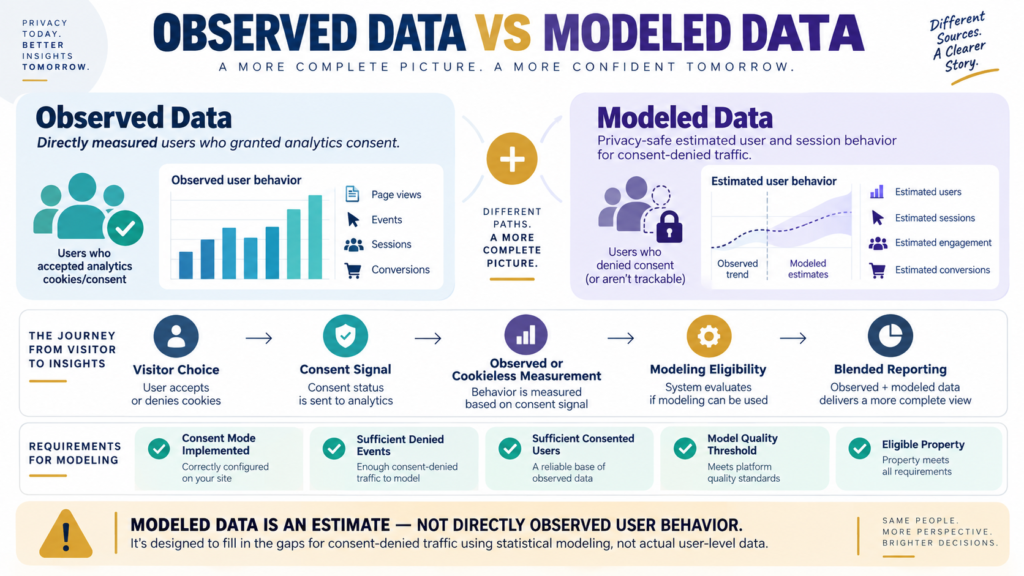
Cookie-consent choices can create gaps in website analytics.
Some visitors allow analytics storage.
Others decline.
That creates a measurement question:
How can GA4 report useful audience trends when some user behavior cannot be observed in the normal cookie-based way?
Google Analytics 4 can use behavioral modeling for consent mode for eligible properties.
Google explains that behavioral modeling uses machine learning to estimate behavior from users who deny analytics cookies based on patterns from similar users who do grant consent.
That can improve reporting completeness.
But it is important to distinguish:
Observed Data
from:
Modeled Data
What Is Observed Data?
Observed data comes from situations where Analytics has permission to associate measured activity with the relevant identifiers.
In simplified terms:
A user grants the required analytics consent.
GA4 can observe and connect the activity according to its measurement rules.
This is actual measured behavior.
What Is Modeled Data?
Modeled data is estimated.
Google uses machine learning to estimate some user and session behavior that cannot be directly observed because persistent identifiers are unavailable after consent is denied.
That distinction matters.
A modeled user is not:
A secretly identified person who opted out.
It is part of a privacy-safe statistical estimate.
Why Consent Creates Measurement Gaps
Suppose two visitors each generate several page views.
If identifiers are available, GA4 may recognize:
Two users with multiple events.
Without persistent user identifiers, the system may see individual events but be unable to reliably connect them into one user journey.
Behavioral modeling attempts to estimate the missing user- and session-level behavior.
Consent Mode Does Not Provide the Consent Banner
Google’s documentation makes an important distinction:
Consent mode is not itself the cookie banner.
You still need an appropriate consent mechanism or consent-management solution.
Consent mode communicates the user’s consent choices to Google tags, which then adjust their behavior.
Basic vs Advanced Consent Mode
Google currently documents two implementations:
Basic Consent Mode
Google tags are blocked until the visitor interacts with the consent mechanism.
If the visitor does not consent, no data is transferred to Google through those blocked tags.
Advanced Consent Mode
Google tags load with appropriate consent defaults and can send limited cookieless signals when consent is denied; full measurement data is sent when consent is granted.
The implementations therefore provide different modeling inputs.
Behavioral Modeling Has Eligibility Requirements
Not every GA4 property automatically receives behavioral modeling.
Google currently states that eligibility requires, among other criteria:
- Consent mode implemented across relevant pages or screens.
- Advanced consent-mode implementation for web behavioral modeling.
- At least 1,000 events per day with
analytics_storage='denied'for at least seven days. - At least 1,000 daily users sending events with
analytics_storage='granted'for at least seven of the previous 28 days.
Meeting those visible prerequisites still does not guarantee eligibility because Google also applies internal model-quality requirements.
For many small websites:
These thresholds may never be reached.
That is normal.
Small Sites Should Not Assume Modeling Is Available
If your website receives:
100 visitors per day
you probably should not build your reporting process around the assumption that behavioral modeling will fill the gaps.
Use:
- Consent-aware analytics.
- Appropriate trend interpretation.
- Larger date ranges.
Do not invent modeled precision your property does not have.
When Modeling Is Included
Google says modeled behavioral data can be integrated with observed data in reports when the property qualifies.
The reporting experience may therefore show higher user counts than a view using observed-only data.
That does not mean traffic suddenly increased.
It may mean your reporting identity includes modeled behavior.
The Data Quality Indicator Can Help
Google says the data-quality icon can indicate when modeled data is included in reporting.
This is a useful habit:
Before comparing numbers, check whether the reporting configuration changed.
A reported increase can sometimes be:
Measurement-model change
rather than:
Audience-behavior change.
Reporting Identity Matters
Google’s behavioral-modeling documentation explains that eligible modeled data can be included through the Blended reporting identity.
Users with sufficient permissions can change reporting identity settings.
If you compare reports using different reporting identities:
Numbers may differ.
Record the configuration in recurring analysis.
Not Every GA4 Feature Supports Modeled Data
Google currently lists several areas that do not support behavioral modeling in the same way, including:
- Audiences.
- User Explorer.
- Cohort and user-lifetime explorations.
- Retention reports.
- Predictive metrics.
- BigQuery export.
Therefore:
Do not expect every GA4 report to reproduce exactly the same modeled user totals.
Reports and Explorations Can Behave Differently
Google also explains that modeling can be applied differently in path and funnel explorations than in normal reports.
This is another reason two GA4 screens may legitimately show different numbers.
Before calling one wrong:
Check the reporting method.
Modeled Data Is Not Fake Data
Modeled does not mean arbitrary.
Google describes model validation and quality thresholds intended to prevent behavioral modeling from appearing where confidence is insufficient.
Still:
It remains an estimate.
Use the correct language.
Better:
“GA4 reports a modeled estimate.”
Not:
“GA4 directly measured every one of these users.”
Do Not Use Modeled Data to Identify Individuals
Behavioral modeling is intended to restore aggregate measurement insights while respecting consent choices.
Do not treat it as a method for reconstructing the behavior of specific users who declined consent.
That would misunderstand the purpose of the feature.
Consent Mode Changed in 2026
Google also updated its Analytics data controls in 2026.
Starting June 15, 2026, Google said Consent Mode became the relevant control for certain Google Ads cookie and ID usage from Google Analytics, while the Google Signals setting became more focused on signed-in user association for behavioral reporting.
This is another reason older consent-mode tutorials may no longer fully reflect the current control structure.
Use Consent Tools for Their Actual Purpose
Your job is not to maximize the amount of data collected regardless of user choice.
The process should be:
Obtain Consent → Send Consent State Correctly → Measure What Is Permitted → Understand Modeling → Interpret Reports Carefully
That is both more accurate and more sustainable.
Connect This With Acquisition Reporting
Your verified GA4 User Acquisition vs Traffic Acquisition guide remains important because modeled user counts do not remove the distinction between:
First-user acquisition
and:
Session acquisition.
Connect This With Data Quality
If your reports suddenly differ:
Before concluding that traffic changed, ask:
- Did consent implementation change?
- Did reporting identity change?
- Did modeling eligibility change?
- Is modeled data currently included?
Measurement configuration can affect what you see.
A Simple Consent-Modeling Review
Record:
Consent Banner Present?:
Consent Mode Implemented?:
Basic or Advanced?:
Behavioral Modeling Eligible?:
Reporting Identity:
Modeled Data Present?:
Date Configuration Changed:
Observed Trend Before Change:
Observed Trend After Change:
That creates context.
Conclusion
GA4 behavioral modeling can help fill some measurement gaps when visitors deny analytics consent.
But:
Observed data is measured.
Modeled data is estimated.
Behavioral modeling is available only when the property meets Google’s eligibility and model-quality requirements.
Use modeled reporting as aggregate analytical context.
Do not treat it as direct observation of users who declined consent.
Your Next Action
Open your GA4 property and document:
Consent Solution: _____
Consent Mode: Basic / Advanced / Not Confirmed
Reporting Identity: _____
Behavioral Modeling Shown?: Yes / No
Then check the Data quality indicator in one report.
If modeled data is present, write that fact into your recurring analytics notes.
If it is not present:
Do not assume something is broken.
Your property may simply not meet the modeling requirements.
Finally, add one rule to your reporting process:
“Before comparing traffic periods, confirm whether reporting identity or modeled-data status changed.”
That prevents a measurement change from being mistaken for a marketing change.