Google Analytics 4 can provide useful information about the people using your website.
It can also tempt you into conclusions the data does not support.
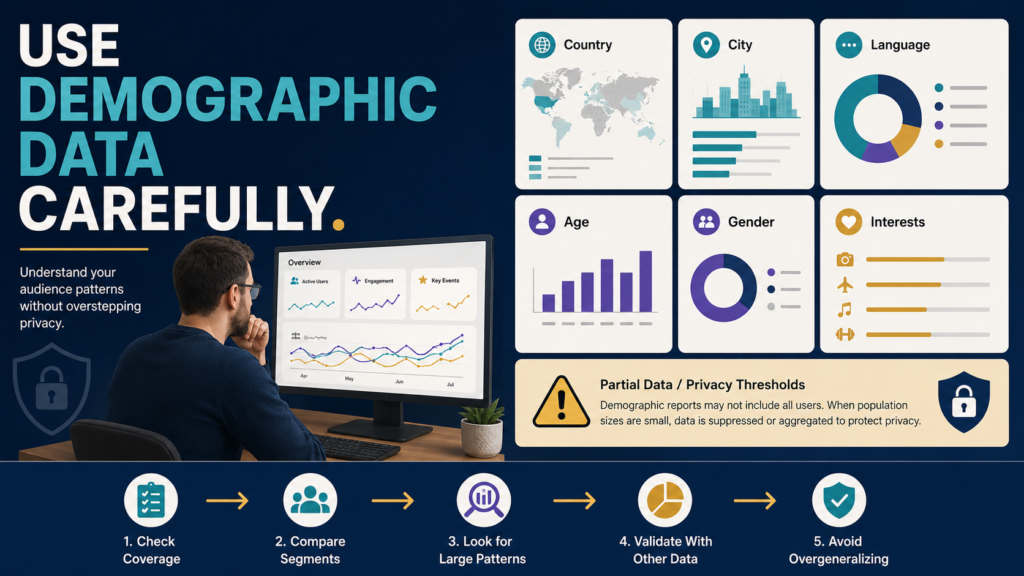
The GA4 Demographic details report can include dimensions such as language, location, age, gender, and interests. However, Google’s current documentation explains that only aggregated information from users who consent to sharing demographic information is included, and privacy thresholds may be applied when user counts are low.
That makes the report useful for identifying broad audience patterns.
It does not mean every percentage shown represents your entire audience perfectly.
Google’s official Demographic details report documentation should be your primary reference when interpreting the report.
Where to Find the Report
Google’s current desktop instructions place the report under:
Reports → User Attributes → Demographic details.
If it does not appear, Google notes that the report may not be part of the current navigation and users with appropriate permissions can add reports back.
Do not assume every GA4 property has identical navigation.
What the Report Can Show
Current demographic dimensions can include:
- Age.
- City.
- Country.
- Gender.
- Interests.
- Language.
- Region.
The report can combine these dimensions with performance metrics such as:
- Active users.
- New users.
- Engaged sessions.
- Engagement rate.
- Average engagement time.
- Event count.
- Key events.
This gives you more context than simply knowing how many people visited.
But context is not the same as certainty.
Why Some Demographic Data Is Missing
This is one of the most important parts of the report.
Google states that demographics and interest information for websites is associated with Google signals and consenting users, and that thresholds may be applied to protect privacy.
Therefore, the data may represent only a subset of your users.
You may also see:
Unknown
for dimensions where Google does not have enough information.
Do not remove “unknown” from your thinking and then treat the remaining known audience as though it represents 100% of visitors.
Example of a Bad Conclusion
Imagine the report shows:
Most identified users fall within one age bracket.
A weak conclusion would be:
“My entire audience is in this age group.”
A better conclusion is:
“Among the demographic information currently available in GA4, this age group appears prominent.”
That wording reflects the limits of the measurement.
Start With Geography
Country and region information can often be easier to act on than inferred interests or demographic characteristics.
Ask:
- Which countries generate the most active users?
- Where is engagement strongest?
- Where are important key events occurring?
- Are you receiving traffic from countries you do not serve?
- Is one region becoming more important over time?
Suppose a U.S.-focused business begins receiving significant traffic from the United Kingdom.
That may create questions about:
- Currency.
- Shipping.
- Tax information.
- Terminology.
- Support hours.
- Product eligibility.
The geographic pattern becomes useful because it affects a real business decision.
Use Language Carefully
Language often reflects browser or device settings rather than a complete description of identity.
Still, it can reveal practical opportunities.
If a substantial part of the audience uses another language, ask:
- Are important instructions understandable?
- Do you need translated resources?
- Is the current content intended for that audience?
- Would localization actually benefit customers?
Do not create an entire multilingual strategy because a handful of visitors use another language.
Look for meaningful patterns.
Age and Gender Need Extra Caution
Age and gender can be tempting because they resemble traditional customer-avatar fields.
But available demographic data may be incomplete.
Do not build a customer persona that says:
“Our buyer is a 45–54-year-old man”
simply because one GA4 table shows that group prominently.
Combine demographic information with:
- Actual customer data.
- Email responses.
- Purchases.
- Surveys.
- Support questions.
- Search behavior.
- Product feedback.
Analytics should inform your understanding of the audience, not manufacture the audience.
Interests Are Clues, Not Identities
GA4 may provide interest categories when qualifying information is available.
Treat them as directional.
An interest category does not mean every individual visitor:
- Identifies with the category.
- Wants content about it.
- Intends to purchase related products.
- Should receive different marketing treatment.
Use interests to generate questions.
Do not use them to create stereotypes.
Compare Engagement Before Acting
Demographic volume alone can be misleading.
Suppose one country produces the most users.
Another country produces fewer users but:
- Higher engagement.
- More key events.
- More purchases.
- Better repeat behavior.
Which one matters more?
The answer depends on your business goal.
That is why the report includes engagement and key-event metrics alongside audience dimensions.
Traffic size is only one part of performance.
Combine Demographics With Acquisition Data
Audience attributes become more meaningful when you understand how visitors arrived.
For example:
A country may look important because a social post briefly went viral there.
Another may produce consistent organic search traffic.
These are different situations.
Use acquisition reports to identify the source of traffic before assuming a demographic pattern reflects your long-term audience.
My guide to GA4 User Acquisition versus Traffic Acquisition explains why first-user acquisition and session acquisition answer different marketing questions.
Check Device Context Too
Audience behavior can also be influenced by technology.
If one segment appears to engage poorly, do not immediately conclude that the audience is uninterested.
Check whether those users disproportionately access the site through a device or browser that has problems.
The GA4 Tech Details report can help isolate browser, device, operating-system, and screen-resolution differences.
That prevents an audience-analysis problem from hiding what may actually be a technical problem.
Small Websites Need More Patience
A large website may produce enough data to reveal stable patterns quickly.
A small website may not.
If you have limited traffic:
- Use longer date ranges.
- Avoid tiny segment comparisons.
- Look for repeated patterns.
- Expect more unknown values.
- Avoid conclusions from a handful of users.
A 70% change based on ten people is very different from a 70% change based on ten thousand.
Always inspect the underlying volume.
Do Not Build Different Content for Every Segment
Demographic reports can create the illusion that sophisticated marketing requires dozens of audience variations.
It usually does not.
A small business might discover:
- Most customers are in two countries.
- Mobile is dominant.
- One broad age group appears frequently.
- English is the primary language.
That may justify a few practical decisions.
It does not require twenty different websites.
Use segmentation when it improves the customer experience.
Avoid complexity simply because analytics makes segmentation possible.
A Practical Monthly Demographics Review
Step 1: Choose a reasonable date range
For a smaller site, consider several months if necessary.
Step 2: Check total data context
Understand how much information is unknown or unavailable.
Step 3: Review geography
Look at country and region patterns.
Step 4: Check language
Identify any meaningful differences.
Step 5: Review age, gender, and interests cautiously
Treat them as partial context.
Step 6: Compare engagement
Look beyond user count.
Step 7: Connect the pattern to a real business decision
Ask:
“What would I actually change because of this information?”
If the answer is:
“Nothing useful”
you may not need to act.
Questions Worth Asking
Instead of:
“Who is my audience?”
ask:
“Which currently measurable audience groups show meaningfully different behavior?”
Instead of:
“Should I market to older people?”
ask:
“Do available age groups show a repeated difference in engagement or key events, and is that pattern supported by other customer evidence?”
Instead of:
“What are my visitors interested in?”
ask:
“Do available interest categories reveal a useful content or offer question worth testing?”
Better questions produce better analysis.
Combine Demographics With Content Performance
Suppose a specific article performs strongly with visitors from one country.
Do not automatically rewrite the entire website for that country.
Check:
- What search query leads to the page?
- Is the topic unusually relevant there?
- Is the page getting referral traffic?
- Is there a temporary event driving interest?
- Do visitors convert?
- Does the pattern persist?
Your existing guide to measuring blog performance in GA4 without relying on page views alone provides a useful framework for evaluating whether traffic is creating meaningful engagement.
Respect the Privacy Purpose of Thresholds
Missing data can be frustrating.
But privacy thresholds exist for a reason.
Google explains that thresholds are designed to prevent users of Analytics from inferring an individual’s identity from demographic or interest information when audience numbers are small.
Do not treat privacy limitations as an analytics defect that needs to be defeated.
Work with the aggregate information available.
Conclusion
The GA4 Demographic details report can help you understand broad audience characteristics, but it should not become a customer-persona generator.
The available demographic information may represent only part of your total traffic, and privacy thresholds can limit what you see.
Use the report for context.
Look for large, repeated patterns.
Compare those patterns with engagement and key events.
Then validate important conclusions using other sources such as customer purchases, surveys, support questions, Search Console, and acquisition data.
The best first step is not building five new customer avatars.
Open the report, identify one meaningful audience pattern, and ask whether that pattern changes a real business decision.
If it does not, keep observing.