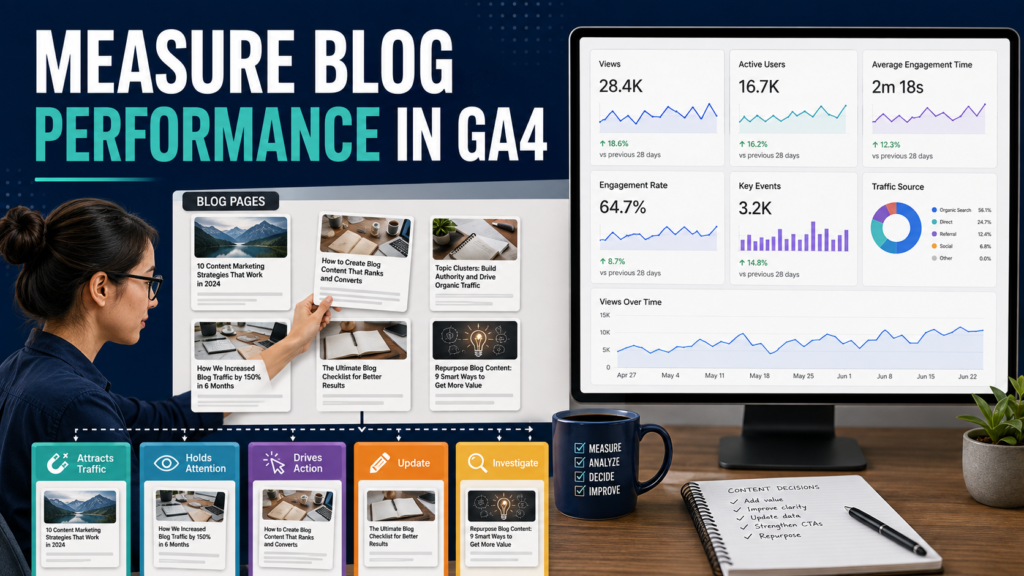
Page views tell you that people loaded an article.
They do not tell you whether the article:
- Held attention.
- Attracted the right visitors.
- Encouraged another action.
- Generated subscribers.
- Supported a product page.
- Deserves to be updated.
Google Analytics 4 provides several reports and metrics that can help you examine those questions.
Google’s current Engagement overview is designed to summarize engagement information, compare engagement metrics over time, show which pages people visit, and identify features they interact with.
A useful blog-performance review combines three questions:
Did people reach the article?
Did they engage with it?
Did they complete a meaningful next action?
Key Takeaways
- Do not rank blog posts by page views alone.
- Use Pages and Screens to compare page-level activity.
- Review active users and engagement.
- Define meaningful key events.
- Add traffic-source context.
- Compare similar article types.
- Use performance data to decide what to update, expand, promote, or leave alone.
Begin With the Purpose of the Article
Not every article has the same job.
Possible purposes:
Search Education
Answer a Google search question.
Lead Generation
Introduce a lead magnet.
Commercial Investigation
Help a reader evaluate software.
Product Education
Explain a problem connected to your own product.
Traffic Support
Attract readers who may later explore other resources.
If you do not define the job, you cannot judge success properly.
Open the Pages and Screens Report
Google’s current Pages and Screens report is designed to show information about the individual pages and screens users viewed.
Depending on your GA4 report configuration, useful dimensions may include:
- Page title.
- Page path.
- Page title and screen class.
Useful metrics can include:
- Views.
- Active users.
- Views per active user.
- Average engagement time.
- Event count.
- Key events.
Do not assume your property displays every metric by default.
Reports can be customized.
Start With Views
Views answer:
How often was this page viewed?
This helps identify:
- Popular articles.
- Recent spikes.
- Evergreen pages.
- Pages with little visibility.
Views are useful.
They are not sufficient.
An article can receive thousands of views and still fail to support the action you care about.
Review Active Users
Active users give you another view of audience size.
A page with:
- 2,000 views.
- 500 active users.
has a different usage pattern from a page with:
- 2,000 views.
- 1,900 active users.
Neither is automatically better.
The first may be revisited frequently.
The second may attract many unique readers.
Look at context.
Understand Engagement
GA4 defines an engaged session as one that lasts longer than 10 seconds, has a key event, or includes at least two page or screen views.
This means engagement rate is not simply:
“Did the person read every word?”
It is a session-level measurement based on Google’s engaged-session definition.
Use it as one signal.
Review Average Engagement Time
Average engagement time can help identify pages where users spend more active time.
But long time is not automatically good.
Imagine:
Article A
“GetResponse Login Instructions”
A reader finds the link in 20 seconds.
Success.
Article B
“Complete Guide to Building an Email List”
A reader spends 7 minutes.
Also success.
Article intent affects interpretation.
Compare Similar Pages
Avoid comparing:
- 300-word announcement.
- 3,000-word guide.
- Checkout page.
- Contact page.
as though they should produce identical behavior.
Group blog content by type.
Tutorials
Compare with tutorials.
Reviews
Compare with reviews.
Buying Guides
Compare with buying guides.
Short Updates
Compare with short updates.
This creates more useful benchmarks.
Define Key Events
GA4 currently uses key events for actions particularly important to the business. Google explains that reports can count how often users trigger these important events and use them in attribution reporting.
For a content site, useful key events might include:
- Lead-magnet signup.
- Contact submission.
- Purchase.
- Course enrollment.
- Important account registration.
Do not mark every ordinary interaction as a key event.
Focus on important outcomes.
Connect Articles With Subscriber Actions
Suppose two articles each receive 1,000 views.
Article A produces:
- 40 lead-magnet signups.
Article B produces:
- 2 signups.
That does not automatically mean Article A is better.
Maybe Article B is an early informational article with no relevant lead magnet.
But now you have a useful question:
Should Article B have a better next step?
Analytics should generate questions.
Connect Pages With Traffic Sources
An article may perform differently according to source.
Visitors from:
- Google Search.
- Newsletter.
- Facebook.
- LinkedIn.
- YouTube.
- Referral sites.
can behave differently.
Add acquisition context when useful.
For example:
A software review may receive fewer sessions from email but stronger product-page clicks.
A beginner guide may attract large search traffic but fewer immediate conversions.
Different roles.
Review Landing-Page Performance
If a blog article is frequently the first page of a session, it is serving as an entry point.
Google’s Landing Page report focuses on the first page a visitor reaches during a session.
Ask:
- Which blog posts introduce new visitors?
- Do those visitors engage?
- What do they do next?
- Do important articles receive no entry traffic?
This adds another performance dimension.
Build a Simple Blog Scorecard
For each important article, record:
Article:
Primary purpose:
Views:
Active users:
Average engagement time:
Engagement rate:
Key events:
Main traffic source:
Published date:
Last updated:
Decision:
Possible decisions:
- Keep.
- Promote.
- Update.
- Expand.
- Improve CTA.
- Investigate.
- Retire.
Do not create one numerical score that hides important context.
Find Your Traffic Winners
Traffic winner:
An article consistently attracts visitors.
Ask:
- Which channel sends them?
- Does the topic fit your audience?
- Can the page be updated?
- Does it have a useful next step?
Do not rewrite a successful article simply to make it “fresh.”
Make changes when they improve the reader experience or correct outdated information.
Find Your Engagement Winners
Some articles may receive moderate traffic but strong engagement.
These may reveal:
- High-interest topics.
- Useful long-form content.
- Strong audience fit.
- Good examples.
Consider:
- Creating a related article.
- Expanding a cluster.
- Building a lead magnet.
- Creating a video.
Do not assume high engagement proves commercial intent.
Find Your Action Winners
These articles produce meaningful key events.
Examples:
- Subscriber signups.
- Product-page clicks.
- Purchases.
Study:
- Topic.
- Search intent.
- CTA.
- Traffic source.
- Offer alignment.
The lesson may not be:
“Copy this article.”
It may be:
“The CTA is closely aligned with the reader problem.”
Find Underperformers
An underperforming article may have:
Low traffic, good engagement
Distribution or search visibility may be the problem.
High traffic, low engagement
Intent mismatch, poor opening, or wrong audience may be involved.
High engagement, no action
The next step may be weak or unnecessary.
Low traffic and low engagement
The article may need substantial improvement—or may not deserve priority.
Diagnose before editing.
Use Date Comparisons
Compare:
- Last 90 days.
- Previous 90 days.
Or:
- This year.
- Same period last year.
Look for:
- Growing pages.
- Declining pages.
- Seasonal patterns.
- Sudden changes.
Do not overreact to a single week.
Record Major Changes
If you rewrite an article, record:
- Date.
- What changed.
- Why.
- Baseline metrics.
Otherwise you may not remember why performance shifted.
Example:
August 11: Rewrote introduction, updated 2024 pricing, added new comparison section.
Later you can evaluate whether the change was helpful.
Use Search Console With GA4
GA4 helps explain on-site behavior.
Search Console helps explain Google Search performance.
For one article, Search Console may show:
- Impressions.
- Clicks.
- Queries.
GA4 may show:
- Engagement.
- Key events.
- Traffic from other channels.
Together they provide a fuller picture.
Example: Three Blog Posts
Imagine:
Article 1
10,000 views.
Low engagement.
Almost no key events.
Article 2
2,000 views.
High engagement.
75 signups.
Article 3
800 views.
High engagement.
15 product purchases.
Which is best?
There is no single answer.
Article 1 may be a broad traffic asset.
Article 2 may be a strong lead-generation asset.
Article 3 may be a commercially valuable buying guide.
The business needs all three roles.
Create a Monthly Content Review
Once a month:
Step 1
Identify top pages by views.
Step 2
Identify high-engagement pages.
Step 3
Identify pages associated with key events.
Step 4
Identify meaningful declines.
Step 5
Review traffic sources.
Step 6
Choose no more than a few pages to improve.
Do not spend every month redesigning the entire site.
Questions to Ask About Every Important Article
- What is this page supposed to do?
- Is it attracting visitors?
- Where do they come from?
- Do they engage?
- Do they complete a useful action?
- Is the information current?
- Does the page need a stronger next step?
- Is another article answering the same question better?
These questions convert analytics into editorial decisions.
Common Measurement Mistakes
Ranking articles only by views
Reach is only one dimension.
Treating engagement time as reading time
GA4’s engagement metrics have specific definitions.
Marking too many key events
Prioritize real business actions.
Comparing unrelated page types
Context matters.
Ignoring traffic sources
Audience intent differs by channel.
Making changes without recording them
Maintain a revision log.
Deleting low-traffic articles automatically
A niche article may still serve an important audience or business purpose.
Conclusion
Measuring blog performance in GA4 is most useful when you stop asking, “Which article has the most views?” and start asking what each page is accomplishing.
Use page-level reports to evaluate reach. Review engagement to understand interaction. Define key events for meaningful actions. Add traffic-source and landing-page context when needed.
Then make one of several decisions:
Keep, improve, expand, promote, investigate, or retire.
Open GA4 and choose ten important blog posts. Record their purpose, views, engagement, and key events before deciding which content deserves your next update.