Google Analytics 4 can report more than one rate for important actions.
Two that can look especially similar are:
User key event rate
and:
Session key event rate
They sound almost interchangeable.
They are not.
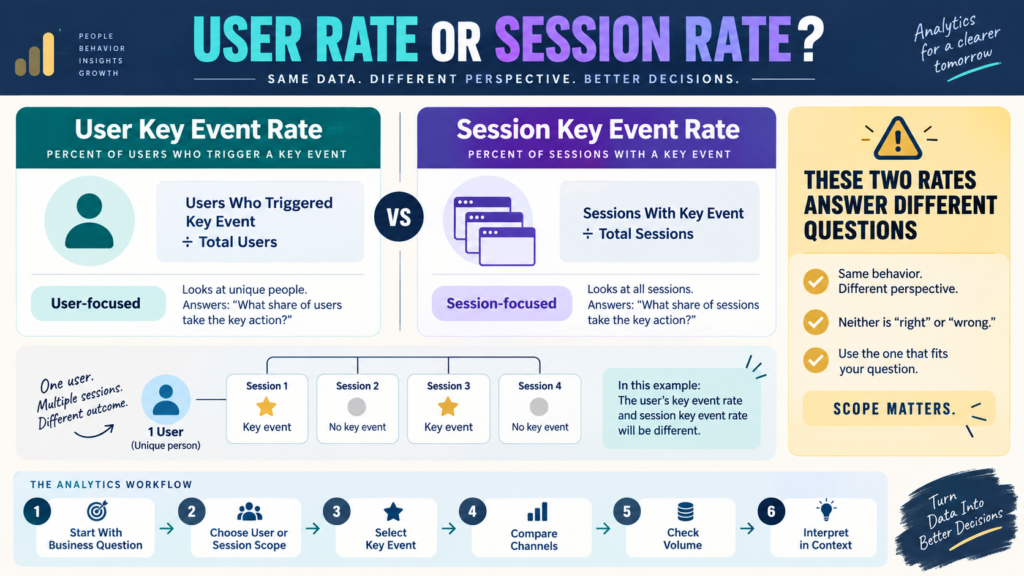
Google currently defines User key event rate as the percentage of users who triggered a key event:
Users Who Performed a Key Event ÷ Total Users.
Google defines Session key event rate as the percentage of sessions in which a key event occurred:
Sessions Containing a Key Event ÷ Total Sessions.
The difference is scope.
One asks about:
People
The other asks about:
Visits
Start With the Business Question
Before choosing the metric, ask what you want to know.
User Question
What percentage of people eventually performed this important action?
Use:
User Key Event Rate
Session Question
What percentage of visits contained this important action?
Use:
Session Key Event Rate
Both are useful.
They answer different questions.
What Is a Key Event?
GA4 uses events to measure actions.
You can mark important events as key events.
Examples might include:
generate_leadpurchasesign_up- Another event you configure as important.
Google’s current acquisition reports calculate key-event rates automatically after the relevant event is configured as a key event.
The quality of the rate therefore depends heavily on the quality of your event setup.
Example: One User, Three Sessions
Imagine one visitor.
Session 1
Reads an article.
No lead.
Session 2
Returns two days later.
Reads another article.
No lead.
Session 3
Returns through email.
Completes your signup form.
Now look at the two perspectives.
User Perspective
One user.
One user completed the key event.
For that one-user example:
User key event rate = 100%
Session Perspective
Three sessions.
One session contained the key event.
Session key event rate = 33.3%
Neither metric is wrong.
They describe the same journey from different levels.
User Key Event Rate Is Useful for Audience Questions
Suppose you want to know:
What percentage of users acquired through Organic Search eventually generate a lead?
A user-oriented rate can be useful.
Google’s User Acquisition report currently includes User key event rate and organizes acquisition dimensions around how users were first acquired.
This can help answer questions about:
- New-user quality.
- First acquisition channel.
- Audience-level outcomes.
Session Key Event Rate Is Useful for Visit Questions
Suppose you want to know:
What percentage of Email sessions contain a purchase?
The Traffic Acquisition report’s Session key event rate fits that question because it evaluates sessions.
Google defines the rate as:
Sessions with key event ÷ total sessions.
This can be useful when comparing:
- Organic Search sessions.
- Email sessions.
- Referral sessions.
- Paid Search sessions.
Do Not Compare the Two as If One Should Be Higher
A user may visit several times before taking action.
Therefore, the two percentages can diverge naturally.
This is especially common for:
- Higher-priced purchases.
- Email-list signup after repeated visits.
- Course purchases.
- Software decisions.
- Complex services.
People do not necessarily convert in their first session.
Example: 100 Users and 180 Sessions
Suppose:
100 users
generated:
180 sessions
and:
20 users
performed your lead key event.
Suppose those key events occurred across:
22 sessions
Then:
User Key Event Rate
20 ÷ 100 = 20%
Session Key Event Rate
22 ÷ 180 = 12.2%
Again:
Different denominators.
Different questions.
Choose One Specific Key Event
A website may have several key events.
Examples:
- Newsletter signup.
- Product purchase.
- Checkout start.
- Contact request.
Do not casually discuss:
“the conversion rate”
without knowing which key event is being evaluated.
Google’s reporting lets you narrow relevant metrics to particular key events in supported reports.
Use User Rate for Longer Customer Journeys
A user-focused metric may be more intuitive when you care about whether a person ultimately completes an important action during the measured period.
Examples:
Did a visitor become a lead?
Did an acquired user purchase?
Did the audience eventually reach the desired action?
It reduces the emphasis on how many separate visits occurred before completion.
Use Session Rate for Traffic Efficiency
A session-oriented metric can help answer:
How productive are visits from this source?
For example:
Email sessions may have a higher session key event rate than broad informational Organic Search sessions.
That does not automatically mean email “caused” better visitors.
Email visitors may already know the business.
Use the rate descriptively.
Connect the Metric to Acquisition Scope
GA4 already distinguishes:
User Acquisition
from:
Traffic Acquisition
The GA4 User Acquisition vs Traffic Acquisition guide explains why first-user and session traffic dimensions answer different questions.
The same thinking applies here.
User-scoped questions belong naturally with user metrics.
Session-scoped questions belong naturally with session metrics.
Do Not Ignore Volume
Suppose:
Channel A session key event rate:
20%
Channel B:
10%
Channel A generated:
10 sessions.
Channel B generated:
10,000.
Do not make a major marketing decision from the percentages alone.
Always examine:
- Users.
- Sessions.
- Key-event count.
- Rate.
A high rate built from tiny volume may be unstable.
Do Not Treat Every Event as a Key Event
If every interaction is marked as a key event:
The rate becomes less useful.
A key event should represent an action that matters to the business.
Examples might include:
- Lead.
- Purchase.
- Important registration.
Routine page views generally answer a different question.
Use Engagement Metrics Separately
A user can engage meaningfully without completing a key event.
The GA4 Engagement Overview can help you analyze that behavior separately.
Think:
Engagement tells you whether visitors interact.
Key events tell you whether defined important actions occur.
Example: Blog Subscriber Funnel
Your goal:
Email signup
Organic Search
1,000 users
1,300 sessions
50 users sign up
55 sessions contain signup
User key event rate:
5%
Session key event rate:
4.2%
Email Traffic
200 users
400 sessions
30 users purchase another product
The relevant rate depends on the question.
Do not force every channel into one interpretation.
Track the Same Rate Over Time
If you decide:
Session key event rate is the best metric for this campaign analysis
keep using that rate when comparing periods.
Do not compare:
Last month User key event rate
with:
This month Session key event rate
and call the difference improvement.
Key Event Rate Is Not Revenue
A signup may count as a key event.
A purchase may also count.
They do not have equal business value.
For ecommerce, pair key-event rates with:
- Purchase revenue.
- Transactions.
- Average revenue.
- Product performance.
For lead generation, pair the rate with:
- Lead quality.
- Qualified leads.
- Customer conversion.
Google now provides dedicated lead reports using recommended events for businesses that implement that measurement structure.
A Simple Decision Rule
Use:
USER KEY EVENT RATE
when the question begins:
“What percentage of users…”
Use:
SESSION KEY EVENT RATE
when the question begins:
“What percentage of visits or sessions…”
That rule handles many situations.
A Simple Worksheet
Business Goal:
Key Event:
Question: User or Session?
Total Users:
Users With Key Event:
User Key Event Rate:
Total Sessions:
Sessions With Key Event:
Session Key Event Rate:
Traffic Source:
Volume Large Enough?:
Action Needed?:
Conclusion
GA4 User key event rate and Session key event rate are both valid measures.
But they answer different questions.
User key event rate:
What percentage of users triggered the important action?
Session key event rate:
What percentage of sessions contained the important action?
Choose the metric based on the scope of the business question.
Then keep that scope consistent when comparing:
- Channels.
- Campaigns.
- Dates.
- Audiences.
Do not treat one as universally better.
Your Next Action
Choose one important GA4 key event, such as:
generate_lead
or:
purchase
Then write two questions:
User Question: What percentage of users performed this action?
Session Question: What percentage of sessions contained this action?
Open the relevant GA4 reports and record:
User Key Event Rate: _____
Session Key Event Rate: _____
Users: _____
Sessions: _____
Key Events: _____
Now decide which rate better answers the business question you are currently trying to solve.
Use that same metric consistently in your next monthly comparison.