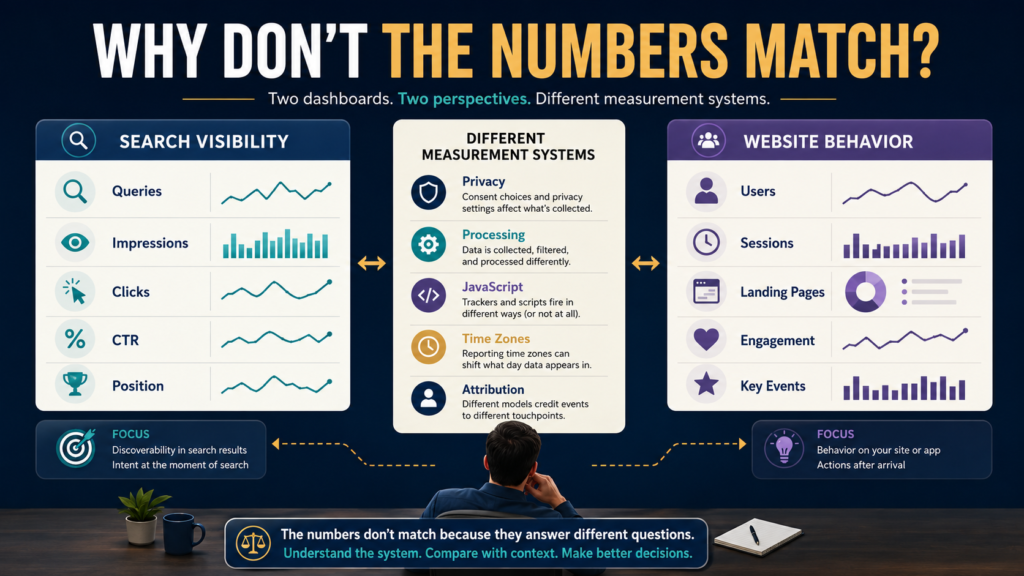
You open Google Search Console and see one number for clicks from Google Search.
Then you open Google Analytics 4 and see a different number for organic users or sessions.
Which one is wrong?
Possibly neither.
Search Console and GA4 are different measurement systems designed to answer different questions.
Google’s own Search Console documentation explains that discrepancies can result from privacy protections, data processing, reporting delays, time zones, and the fact that Analytics relies on browser-based measurement such as JavaScript.
Instead of trying to force the totals to match, use each platform for the part of the customer journey it measures best.
The Simplest Difference
Think of the tools this way:
Search Console
What happened in Google Search before and during the click?
It helps analyze:
- Search queries.
- Impressions.
- Clicks.
- Click-through rate.
- Average position.
- Landing pages in Google Search.
- Search appearance.
- Devices and countries.
Google Analytics 4
What happened when measured visitors reached and used the website?
It helps analyze:
- Users.
- Sessions.
- Landing pages.
- Engagement.
- Traffic acquisition.
- Events.
- Key events.
- User journeys.
That difference alone explains why comparing “Search Console clicks” directly with “GA4 users” is not an apples-to-apples comparison.
A Click Is Not a User
One person may click from Google more than once.
That could produce multiple Search Console clicks.
GA4 may identify website activity differently depending on its measurement model, consent, browser behavior, session rules, and tracking availability.
Likewise:
Clicks ≠ users ≠ sessions.
Do not expect those columns to contain identical numbers.
Privacy Can Remove Some Search Console Detail
Google states that Search Console does not show all Performance data in order to protect user privacy. Low-frequency queries, for example, may be omitted from detailed reporting.
That means adding every visible query row may not reproduce the complete total you see elsewhere in the Search Console interface.
Do not conclude that missing query rows represent a tracking error.
Processing Can Change Totals
Search Console performs processing that can affect how statistics appear.
Google specifically identifies processing such as duplicate elimination as one reason Search Console numbers can differ from other sources.
GA4 has its own processing and attribution logic.
Two systems can observe related activity while organizing it differently.
JavaScript Creates Another Difference
Google notes that Analytics products may track website activity only when JavaScript is enabled and able to run.
A Search Console click occurred at Google.
Whether that click becomes measurable GA4 activity depends on what happens on the destination website.
Possible interruptions include:
- User closes the page quickly.
- Tracking does not load.
- Browser technology interferes.
- Consent settings prevent analytics measurement.
- JavaScript is disabled.
- Page redirects behave unexpectedly.
- Analytics implementation is broken.
The Search click and website measurement are related but not identical events.
Time Zones Can Make Daily Comparisons Look Wrong
Search Console’s standard Performance views use Pacific Time, while the 24-hour view uses local browser time. Google Analytics properties can use their configured reporting time zone.
Suppose GA4 defines a day according to Central Time and Search Console defines the standard daily period in Pacific Time.
Activity near midnight may land on different dates.
Monthly totals may appear much closer than individual daily totals.
This is why a one-day discrepancy should not automatically trigger a tracking investigation.
Data Freshness Is Different
Search Console data can involve a reporting delay, and its latest numbers may be preliminary.
Google’s documentation says collected Search Console data is normally available within about two to three days in standard reporting, while recent Performance data can be preliminary.
If you compare today’s mature GA4 reporting with Search Console data that is still incomplete, the gap may be temporary.
How the Official Search Console–GA4 Integration Helps
Google allows a Search Console property to be connected to a GA4 web data stream.
The integration can add two useful report types:
- Google Organic Search Queries.
- Google Organic Search Traffic.
Google says the Organic Search Traffic report combines landing pages with Search Console and Analytics metrics, helping you look at search acquisition and on-site activity within a more connected reporting environment. Search Console data appearing through the integration can cover up to 16 months and is available in Analytics about 48 hours after Search Console collects it.
This does not make Search Console and GA4 become the same measurement system.
It makes comparison easier.
Compare Questions, Not Just Totals
A better workflow starts with the question.
Question: Is Google showing my pages more often?
Use Search Console impressions.
Question: Are searchers clicking?
Use Search Console clicks and CTR.
Question: Which queries lead people to the website?
Use Search Console.
Question: Which organic landing pages engage visitors?
Use GA4, optionally combined with Search Console data.
Question: Are organic visitors completing key actions?
Use GA4.
Question: Did my Google search visibility decline?
Begin with Search Console.
Question: Did website engagement change after the traffic decline?
Use GA4.
Each tool contributes a different piece.
Use Trends Before Exact Reconciliation
Suppose Search Console clicks fall 30% over several weeks.
GA4 organic traffic also falls substantially.
The two percentages do not need to match exactly for the combined evidence to matter.
Conversely:
Search Console clicks remain stable.
GA4 reports a sudden collapse in organic sessions.
That could suggest a website analytics problem rather than an SEO collapse.
This is why a trend comparison can be more useful than asking whether 243 clicks should equal 243 sessions.
For broader content-performance analysis, measuring blog performance in GA4 without relying on page views alone provides a more complete way to evaluate what visitors do after reaching an article.
A Five-Step Reconciliation Process
Step 1: Match the Date Range
Use the same period as closely as possible.
For short date ranges, remember the time-zone issue.
Step 2: Match the Traffic Scope
Do not compare all GA4 website traffic with Search Console Google Search clicks.
Filter GA4 to the relevant Google organic traffic.
Step 3: Match the Landing Page
If diagnosing one URL, compare the same landing page.
Step 4: Check Tracking
If GA4 suddenly changes but Search Console does not, inspect the analytics implementation.
Step 5: Compare Direction
Ask whether both systems support the same broad conclusion.
This is usually more meaningful than exact numerical equality.
Example: Search Console Falls, GA4 Falls
Suppose:
- Search Console impressions fall.
- Search Console clicks fall.
- GA4 Google organic sessions also fall.
Now you have multiple signals suggesting a genuine search-traffic issue.
Move to a structured workflow such as diagnosing a Google Search traffic decline before changing the website.
Example: Search Console Stable, GA4 Falls
Now ask:
- Was analytics code changed?
- Was the consent system changed?
- Did a plugin update?
- Did a tag stop firing?
- Did landing pages redirect?
- Did the GA4 filter change?
- Are you viewing the correct property and data stream?
Do not start rewriting pages just because GA4 dropped.
Search Console stability is evidence worth considering.
Example: Search Console Rises, GA4 Engagement Does Not
You may be gaining search visibility without gaining the right visitors.
Review:
- Queries.
- Landing pages.
- Search intent.
- Engagement.
- Key events.
- Whether the article answers the searcher’s actual need.
More traffic is not automatically better traffic.
Search Console and GA4 Should Work as a Pair
A useful mental model is:
Search Console = Google Search performance
GA4 = website behavior
Search Console helps explain how people found you.
GA4 helps explain what measured visitors did after arrival.
Neither tool replaces the other.
Do Not Build a Daily Reconciliation Spreadsheet
For most small websites, there is little value in trying to account for every missing click every morning.
Instead, establish normal tolerance.
Watch for:
- Large unexplained divergence.
- Sudden tracking breaks.
- Persistent organic decline.
- Unexpected landing-page changes.
- Major differences after site modifications.
That is where investigation becomes worthwhile.
A Monthly Comparison Routine
Once per month:
- Record Search Console impressions.
- Record Search Console clicks.
- Review top queries.
- Review top organic landing pages.
- Review GA4 organic users or sessions.
- Review engagement and key events.
- Identify major differences.
- Investigate only those differences that could affect decisions.
That creates useful measurement without dashboard obsession.
Conclusion
Search Console and GA4 numbers do not have to match exactly because the platforms measure different parts of the user’s journey and process data differently.
Search Console measures what happens in Google Search.
GA4 measures website activity that its analytics implementation can observe.
Privacy, processing, JavaScript, time zones, reporting delays, attribution, and metric definitions can all create legitimate discrepancies.
Use the tools together.
Compare the same date ranges and traffic scope, look for consistent trends, and investigate meaningful divergence rather than chasing perfect numerical agreement.