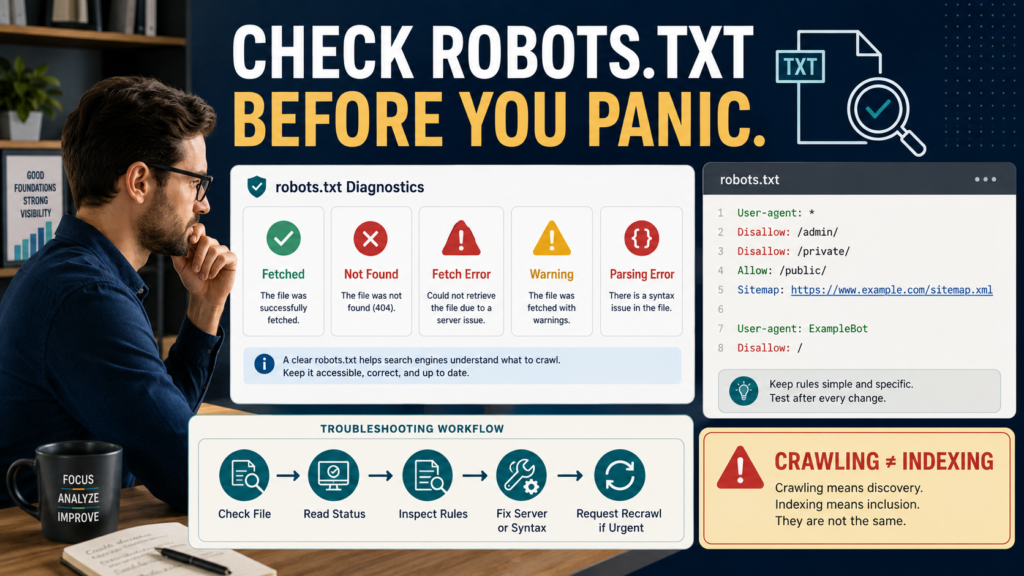
A robots.txt file looks simple.
It is usually a small text file containing rules about which parts of a website search-engine crawlers should or should not crawl.
But one incorrect rule can create a large crawling problem.
Google Search Console includes a robots.txt report that helps site owners see whether Google can fetch and process their robots.txt files, when those files were checked, and whether Google detected warnings or errors.
Google’s current documentation says the report can show robots.txt files for a site’s hosts, their fetch status, last check, file size, and parsing issues. It also allows site owners to request a robots.txt recrawl in important situations.
The useful workflow is:
Check the file → understand its fetch status → review parsing issues → confirm the rules match your intention → investigate any affected URLs → request a recrawl only when needed.
First: Robots.txt Controls Crawling, Not Guaranteed Indexing
This is the most important concept in the entire report.
Google’s documentation states that robots.txt is used to prevent crawling. If the goal is to keep a page out of Google Search, Google recommends using noindex while still allowing Google to crawl the page so it can see that instruction.
That means:
Blocked from crawling
is not automatically the same as:
Guaranteed not to appear in search results.
This distinction prevents many SEO mistakes.
Where the Report Is Available
Google says the robots.txt report is available for host-level properties, including Domain properties and URL-prefix properties without a path. A URL-prefix property that represents only a subdirectory does not qualify in the same way.
If you cannot find the report, first confirm the property type.
What the Report Shows
The report can show:
- Robots.txt file path.
- Fetch status.
- Last checked time.
- File size.
- Parsing issues.
- Previously fetched versions.
- The last fetched file contents.
For Domain properties, Google may check robots.txt files across multiple hosts and HTTP/HTTPS origins.
This can be useful when a website has:
www.- Non-
www. - Subdomains.
- HTTP.
- HTTPS.
Do not assume every host shares one universal robots.txt file.
Status: Fetched
Fetched means Google’s latest attempt successfully retrieved the robots.txt file.
That is good.
But it does not mean every rule inside the file is correct.
Next, inspect:
- Warnings.
- Errors.
- Important
Disallowrules. - Whether critical resources are blocked.
- Whether the current file matches what you intended.
A successfully fetched bad rule is still a bad rule.
Status: Not Found
Google’s documentation says a 404 for robots.txt generally means the file does not exist.
That is not automatically an error.
If there is no robots.txt file, Google can normally crawl the site without robots.txt restrictions. Google may eventually stop showing a consistently missing file in the report while continuing to check in the background.
Do not create a complicated robots.txt file merely because you think every website must have one.
Status: Other Fetch Error
A more serious situation is when Google cannot retrieve the file because of another server or availability problem.
Then investigate:
- Server availability.
- DNS.
- Firewall behavior.
- Authentication.
- Redirects.
- Hosting problems.
- Incorrect response codes.
If Google cannot reliably retrieve your robots.txt file, crawling behavior can be affected.
Parsing Errors and Warnings
The report can identify syntax issues.
Google distinguishes between:
Errors: Rules with errors may not be used as intended.
Warnings: They do not necessarily stop Google from using valid rules, but they deserve review.
Do not edit unfamiliar robots.txt syntax based on guesswork.
Refer to Google’s current robots.txt documentation when necessary. Google’s robots.txt creation and testing documentation
Review the Exact File Google Fetched
The live robots.txt file you see today may not be the same version Google previously fetched.
Search Console lets you view the last fetched content and recent versions when changes produced different results.
This is useful when you ask:
“Why does Google still think this URL is blocked? I changed robots.txt yesterday.”
First confirm which version Google actually retrieved.
Requesting a Recrawl
You generally do not need to request a recrawl every time you touch robots.txt.
Google says its crawlers refresh robots.txt automatically and that manual recrawl requests are mainly useful after important changes or critical fixes—for example, when you have just removed an accidental block from important URLs.
A recrawl request does not guarantee that every newly unblocked page will be crawled immediately.
It refreshes Google’s robots.txt understanding.
Example: Accidentally Blocking the Entire Website
A dangerous rule could effectively tell the relevant crawler not to crawl the site.
If this occurred during development and accidentally remained after launch, your workflow should be:
- Confirm the live robots.txt file.
- Correct the rule.
- Confirm the corrected file is publicly accessible.
- Validate the syntax.
- Request a robots.txt recrawl if the situation is urgent.
- Inspect important pages.
- Monitor Page Indexing and crawling.
My guide to using the Search Console Page Indexing report without trying to index every URL is useful for reviewing whether important pages remain unexpectedly excluded.
Example: Blocking an Admin Area
Some robots.txt restrictions can be completely intentional.
You may want to prevent crawling of low-value or private-looking technical paths.
The correct question is not:
“Is anything blocked?”
It is:
“Is anything important blocked unintentionally?”
Do not remove legitimate rules just to make the report look cleaner.
Robots.txt and Sitemaps Solve Different Problems
A sitemap helps search engines discover URLs you want them to know about.
Robots.txt controls crawling permissions.
Submitting a URL in a sitemap does not override a robots.txt block.
If your sitemap includes an important page but robots.txt prevents Google from crawling it, fix the underlying conflict rather than repeatedly resubmitting the sitemap.
For the discovery side of the process, see my guide to the Search Console Sitemaps report.
Robots.txt and URL Inspection
If one important page appears blocked or inaccessible, use URL Inspection.
It can help answer page-level questions such as:
- Can Google access the page?
- What did Google see?
- Is crawling allowed?
- What indexing information is available?
My Search Console URL Inspection troubleshooting workflow is more appropriate for one suspicious URL than trying to interpret the entire website from the robots.txt report alone.
Robots.txt and Crawl Stats
The robots.txt report tells you whether Google can retrieve and process the crawler rules.
Crawl Stats helps you understand actual Googlebot crawling activity at a broader level.
If you are diagnosing unusual crawl behavior, use them together.
The Search Console Crawl Stats report guide provides that larger crawl perspective.
Do Not Use Robots.txt as a Security System
Robots.txt files are publicly accessible.
Do not put secret information in them.
Do not treat:
Disallow: /private-folder/
as password protection.
A crawler directive does not make content private.
Use proper authentication, access controls, or other security mechanisms for confidential information.
Do Not Block Pages Just to “Save Crawl Budget”
Most smaller websites do not need elaborate crawl-budget strategies.
Blocking useful pages, CSS, JavaScript, images, or resources without understanding the consequences can create more problems than it solves.
Make rules for a clear reason.
A Practical Robots.txt Audit
Review:
File Availability
Can the robots.txt URL be opened publicly?
Fetch Status
Does Search Console show it as successfully fetched?
Parsing
Are there errors or warnings?
Important Rules
Are important pages unintentionally blocked?
Host Variations
Do HTTP, HTTPS, www, or subdomains have different files?
Site Changes
Was a temporary staging rule accidentally left behind?
Sitemap Relationship
Are your sitemaps pointing toward pages robots.txt prevents Google from crawling?
Page-Level Verification
Use URL Inspection for important affected pages.
Common Mistakes
Mistake 1: Assuming Robots.txt Removes a Page From Google
It is primarily a crawling control.
Mistake 2: Blocking the Whole Site During Development and Forgetting
Check before launch.
Mistake 3: Fixing the File but Never Checking Google’s Fetched Version
Confirm Search Console has recognized the change.
Mistake 4: Requesting Recrawls Repeatedly
Use them when they solve a real urgency.
Mistake 5: Ignoring Subdomains
Each host can have its own robots.txt behavior.
Mistake 6: Editing Rules Without Understanding Them
Small syntax changes can have large effects.
Conclusion
The Search Console robots.txt report is not a score you need to make perfect.
It is a diagnostic tool.
Use it to confirm that Google can retrieve your robots.txt files, understand errors and warnings, review the rules Google actually fetched, and identify accidental crawl restrictions.
Most importantly, remember the distinction:
Robots.txt controls crawling. It is not a universal method for removing pages from Google’s index.
When an important page appears affected, combine the robots.txt report with Page Indexing, Crawl Stats, and URL Inspection instead of guessing from one report.