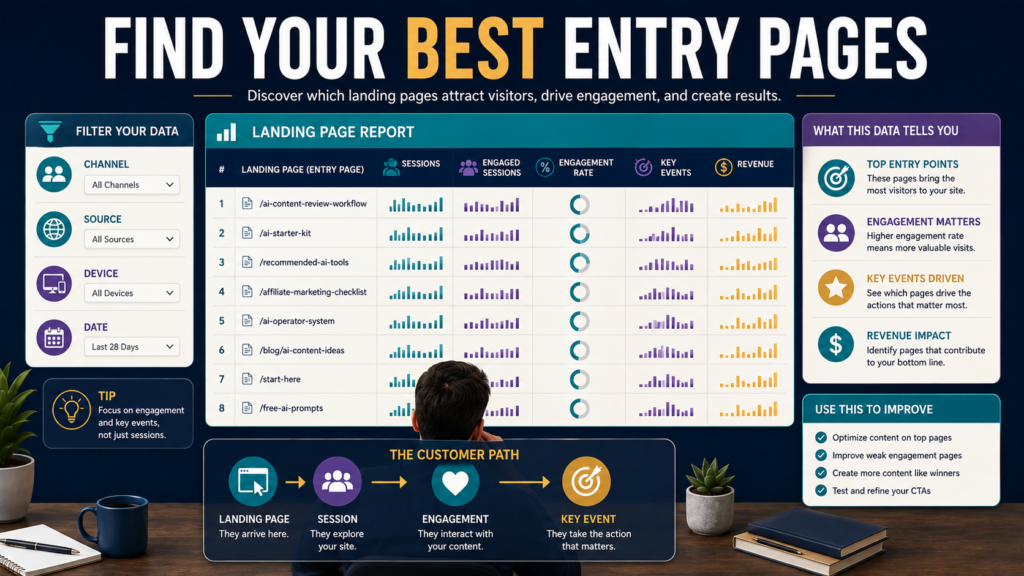
Not every page view begins a visit.
A visitor might enter your website through a blog post, product review, homepage, lead-magnet page, or old article found in Google.
The GA4 Landing Page report helps identify those starting pages.
Google defines a landing page in this report as the first page a visitor sees when arriving at your website. The report is designed to show which pages people initially land on and how those visits perform afterward.
That makes the report useful for answering a practical marketing question:
Which pages are not only attracting visitors, but starting useful sessions?
The best analysis is not:
Which page has the most traffic?
It is:
Which landing pages attract the right visitors and lead to meaningful engagement or business actions?
Where the Landing Page Report Fits
GA4 contains many reports, and using the wrong one for the question creates confusion.
The Landing Page report is especially useful when you want to analyze:
- Entry pages.
- Sessions that begin on individual pages.
- Engagement after arrival.
- Key events.
- Revenue when applicable.
- Traffic-source differences.
- Content performance by entry point.
Google’s current documentation explains the report and its landing-page dimension. Google Analytics Landing Page report documentation
Landing Page Is Different From Page Views
Suppose someone:
- Lands on Blog Article A.
- Clicks to Product Review B.
- Visits About Page C.
Article A is the landing page for that session.
B and C received page views, but they did not start that visit.
This distinction matters because the question changes from:
What content was viewed?
to:
What content brought someone into the site?
Start With Sessions
Sessions show how many visits began with the landing page in the selected reporting context.
Imagine:
| Landing Page | Sessions |
|---|---|
| /guide-a/ | 1,200 |
| /review-b/ | 750 |
| /checklist-c/ | 430 |
You now know which pages started more visits.
But traffic alone does not tell you whether those sessions were useful.
Add Engagement
Look at metrics such as:
- Engaged sessions.
- Engagement rate.
- Average engagement time where appropriate.
- Key events.
A page receiving 2,000 sessions with weak engagement may need a different type of analysis than a page receiving 500 highly engaged sessions.
This is why relying only on page views can mislead. My guide on measuring blog performance in GA4 without relying on page views alone provides a broader framework for connecting traffic with meaningful behavior.
Key Events Matter More Than Raw Traffic for Some Pages
A lead-generation page may have one primary purpose:
Get a visitor to subscribe.
A review article may aim to:
Help someone evaluate a product and continue to a relevant offer.
A tutorial may aim to:
Solve the user’s problem and guide them to another useful article.
You need metrics aligned with the page’s purpose.
Possible key events might include:
- Form submission.
- Purchase.
- Registration.
- Important button interaction.
- Other configured business actions.
Do not invent key events simply to make every page appear measurable.
Choose events tied to real objectives.
Step 1: Identify Your Important Landing Pages
Begin with the pages that start the most meaningful sessions.
Do not review hundreds of URLs at once.
Start with perhaps:
- Top 10 landing pages overall.
- Top organic-search landing pages.
- Top landing pages for conversions.
- Important commercial pages.
- Recently published pages.
This keeps the analysis manageable.
Step 2: Compare Traffic Sources
A landing page can perform differently depending on where visitors came from.
For example:
Google organic: Visitors may arrive with a specific informational intent.
Email: Visitors already know you.
Social: Visitors may be less committed.
Referral: Context depends on the referring site.
Direct: Attribution can be difficult to interpret.
Filtering by channel or source can reveal differences that the overall total hides.
User Acquisition and Traffic Acquisition Are Different Questions
If you move from Landing Page analysis into acquisition reporting, remember that GA4’s User Acquisition and Traffic Acquisition reports are not interchangeable.
User Acquisition emphasizes how users were first acquired.
Traffic Acquisition focuses on how sessions were acquired.
My guide on GA4 User Acquisition vs Traffic Acquisition explains how to choose the right report for the question being asked.
For landing-page analysis, session context is often especially relevant because a landing page is the entry page for a session.
Step 3: Segment Organic Search
If SEO is your concern, isolate organic search.
Then ask:
- Which pages start the most organic sessions?
- Which have strong engagement?
- Which lead to key events?
- Which attract traffic but little business value?
- Which older articles still bring visitors?
- Which commercial pages receive qualified search traffic?
This gives you a better content-prioritization system than simply sorting articles by total views.
Step 4: Compare Similar Pages
Avoid comparing completely different page types as if they have identical goals.
A tutorial and checkout page should not necessarily have the same:
- Session volume.
- Engagement time.
- Conversion rate.
- Exit behavior.
Group pages by intent:
Informational Articles
Look for relevant traffic, engagement, internal navigation, and appropriate next actions.
Lead-Magnet Pages
Look for visits and completed signups.
Product Reviews
Look for engagement and relevant outbound or purchase actions.
Sales Pages
Look for qualified sessions and conversions.
Resource Pages
Look for use of the resources and navigation into deeper content.
Context matters.
Step 5: Find High-Traffic, Low-Value Entry Pages
One useful analysis is:
High sessions + weak engagement + few useful actions.
That does not automatically mean the page is bad.
Investigate:
- Does the content answer the query quickly?
- Is search intent wrong?
- Is the next step unclear?
- Is the page outdated?
- Is mobile usability weak?
- Are visitors finding the answer and leaving satisfied?
- Is measurement configured correctly?
A short informational answer can legitimately solve a question without producing a long session.
Do not “optimize” solely to increase engagement time.
Step 6: Find Lower-Traffic Pages With Strong Results
These may be more interesting.
Suppose one article gets only 300 sessions but consistently generates:
- Email signups.
- Product clicks.
- Key events.
- Returning users.
That page may deserve:
- Better internal links.
- An updated introduction.
- More promotion.
- Additional related articles.
- A stronger topic cluster.
Traffic volume is only one part of content value.
Step 7: Compare Devices
Mobile landing-page behavior can differ sharply from desktop.
If mobile visitors show weaker performance, inspect:
- Load speed.
- Popups.
- Navigation.
- Text readability.
- Button size.
- Form usability.
- Layout shifts.
- Intrusive elements.
Do not assume the content itself is responsible before checking the user experience.
Step 8: Compare Time Periods
Useful comparisons include:
- Last 28 days vs previous 28 days.
- Current month vs previous month.
- Year over year when seasonality matters.
- Before vs after a major page update.
Avoid drawing conclusions from very small date ranges unless you are investigating a specific event.
Step 9: Combine GA4 With Search Console
GA4 tells you what measured visitors do after reaching the site.
Search Console tells you more about how your site appeared and received clicks in Google Search.
For an organic landing page:
Search Console Can Help With:
- Queries.
- Impressions.
- Search clicks.
- CTR.
- Average position.
GA4 Can Help With:
- Sessions.
- Engagement.
- Key events.
- On-site behavior.
The two platforms should complement each other rather than being forced to produce identical numbers.
What About AI-Assistant Traffic?
Referral and traffic-source reporting continues to become more interesting as users arrive from AI products.
If that is part of your analysis, my guide on tracking AI assistant traffic in Google Analytics 4 explains how identifiable AI referral traffic can be reviewed separately.
You can then examine which landing pages those visits enter through.
Build a Simple Landing Page Scorecard
For your ten most important pages, record:
| Landing Page | Sessions | Engagement | Key Events | Primary Source | Action |
|---|---|---|---|---|---|
| Article A | — | — | — | Organic | Keep |
| Guide B | — | — | — | Improve CTA | |
| Review C | — | — | — | Organic | Update |
Do not create arbitrary scores unless they help you make a decision.
The purpose is prioritization.
Questions to Ask for Every Important Landing Page
- Why do visitors enter here?
- What search or referral intent brought them?
- Does the page deliver what it promises?
- What should a visitor naturally do next?
- Is that next step clear?
- Are visitors engaging?
- Are meaningful events happening?
- Does mobile performance differ?
- Has the trend improved or declined?
- What one change would be most useful?
Those questions turn analytics into action.
Avoid Common GA4 Landing Page Mistakes
Mistake 1: Ranking Pages Only by Sessions
Traffic without context can be misleading.
Mistake 2: Treating Every Exit as Failure
Some visitors leave after getting exactly what they needed.
Mistake 3: Comparing Different Page Types
A tutorial and checkout page have different jobs.
Mistake 4: Ignoring Traffic Source
Visitors from Google and an email list may behave differently.
Mistake 5: Making Large Changes From Tiny Samples
Small numbers can fluctuate dramatically.
Mistake 6: Looking at Data Without a Decision
Analytics should answer a question, not create endless dashboard work.
A Simple Monthly Routine
Once per month:
- Open the Landing Page report.
- Review top entry pages.
- Filter organic traffic when analyzing SEO.
- Check engagement.
- Review configured key events.
- Identify unusual changes.
- Select one to three pages deserving attention.
- Make only evidence-supported improvements.
- Record what changed.
- Review the effect later.
That is enough for many small websites.
Conclusion
The GA4 Landing Page report is most useful when you stop treating traffic as the final result.
Use it to identify which pages begin sessions, where those visitors came from, how they engage, and whether they complete meaningful actions.
Then compare similar pages, segment important traffic sources, and combine GA4 behavior data with Search Console search-performance information when appropriate.
The goal is not to maximize every metric.
It is to identify which entry pages attract useful visitors and where a reasonable improvement could produce a better customer journey.