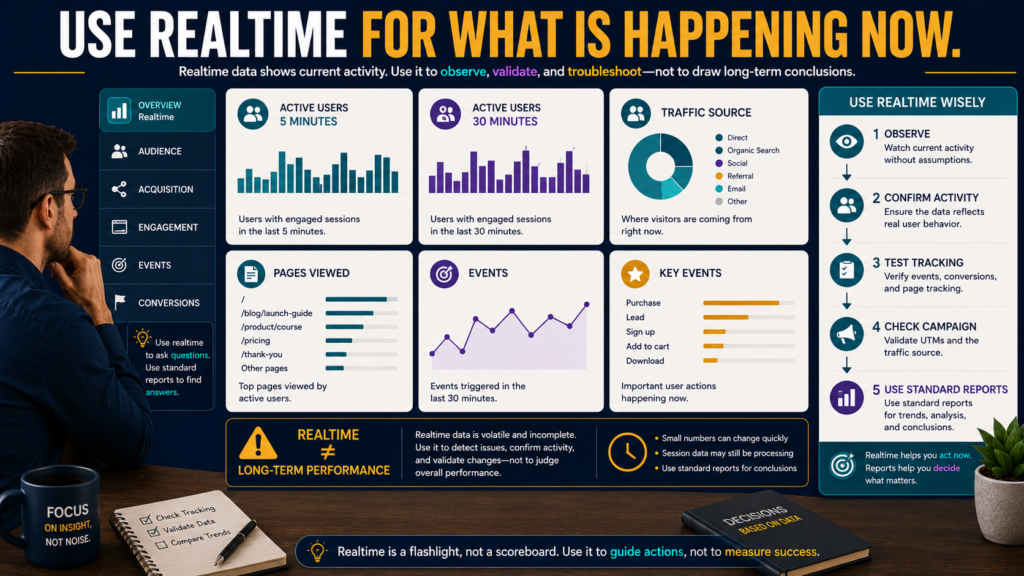
Google Analytics 4 can show website activity only moments after it happens.
That makes the Realtime report one of the most interesting parts of GA4.
You publish a blog post.
Send an email.
Share a link.
Open Realtime.
Visitors appear.
It feels immediate.
The problem is that immediate data can encourage immediate conclusions.
Google’s current GA4 documentation describes Realtime as a report for monitoring activity as it happens. It can show active users during the last 5 and 30 minutes, traffic-source information, pages or screens being viewed, events, key events, audiences, and user properties.
That makes Realtime excellent for:
Observation and verification.
It is usually weaker for:
Long-term performance decisions.
What GA4 Realtime Shows
Current Realtime cards can include:
- Active users in the last 5 minutes.
- Active users in the last 30 minutes.
- First-user source, medium, platform, or campaign.
- Audiences.
- Page titles or screen names.
- Events.
- Key events.
- User properties.
This answers:
What is happening right now?
It does not automatically answer:
Which marketing channel performed best this month?
Use Case 1: Confirm a New Blog Post Is Receiving Visitors
Suppose you publish a new article.
You share it through email.
Open Realtime.
You may be able to see:
- Active users.
- Page title.
- Events.
- Source information.
This confirms that activity is reaching GA4.
But if three users visit immediately, do not conclude:
This article is a winner.
Three users are three users.
Give the content time to accumulate enough data.
Use Case 2: Check a One-Day Promotion
Google specifically lists short promotions as a useful Realtime application.
Suppose you send an email promoting a free checklist at 2:00 PM.
Realtime can help confirm:
- Traffic arrives.
- Correct landing page is receiving views.
- Important events are firing.
- Key events appear.
If no activity appears after you know people clicked the email, investigate the measurement setup.
Use Case 3: Verify Tracking After a Website Change
This is one of Realtime’s best uses.
After changing:
- Analytics tag.
- WordPress plugin.
- Consent tool.
- Form.
- Landing page.
- Checkout tracking.
perform a test.
Then see whether expected activity appears.
You can check:
- Page view.
- Event.
- Key event.
- User activity.
Realtime is not a replacement for a technical debugging tool such as DebugView, but it can quickly confirm whether general activity is reaching the property.
Google notes that DebugView is designed for a different purpose and can focus on a particular debug device, whereas Realtime is available to anyone with access to the property and shows general recent user activity.
Use Case 4: Watch a Traffic Spike
Suppose your website suddenly receives much more activity.
Realtime can help identify:
- Which page people are viewing.
- Where users appear to be coming from.
- Which events are firing.
Possible causes:
- Newsletter mention.
- Social post.
- Referral.
- News event.
- Viral article.
- Bot or unusual traffic.
Do not redesign the business around a 20-minute spike.
Use Realtime to identify what is happening.
Then use standard reporting to understand the broader pattern.
Why Realtime Attribution Is Limited
This is an important limitation.
Google says Realtime performs limited attribution analysis so the report can remain responsive and recommends using Acquisition reports for more accurate attribution information.
Therefore, do not ask Realtime to answer:
Which channel deserves credit for all our sales this quarter?
That is an acquisition and attribution question.
Use standard reports.
Remember the Acquisition Scope
GA4 Realtime currently uses user-scoped dimensions for several acquisition cards, meaning the dimensions relate to how users were first acquired.
This can be confusing when you expect to see the source of the current session.
The verified GA4 User Acquisition vs Traffic Acquisition guide explains why first-user acquisition and session acquisition answer different questions.
Realtime Does Not Replace Traffic Acquisition
Use Realtime for:
What is happening now?
Use Traffic Acquisition for:
How were sessions acquired over the selected period?
Use User Acquisition for:
How were users initially acquired?
Matching the report to the question prevents many GA4 misunderstandings.
Realtime Does Not Replace Content Reporting
Suppose 25 people are currently reading Article A.
That is interesting.
But to evaluate Article A properly, you need:
- Longer date range.
- Users.
- Views.
- Engagement.
- Key events.
- Traffic sources.
- Trend.
The existing GA4 blog-performance framework provides a better system for that type of evaluation.
Realtime and Key Events
Realtime can display key-event activity.
This is valuable when verifying that an important event fires.
For example:
- Open your lead-magnet page.
- Complete the form.
- Confirm the expected event appears.
- Confirm the appropriate key event is visible.
Do not intentionally generate real purchases merely for analytics testing unless your payment and refund process supports safe test transactions.
Use available testing modes where appropriate.
What If Realtime Shows No Data?
Google says a property may show no Realtime data simply because there are no active users.
If you know you are actively testing and still see nothing, check:
- Correct GA4 property.
- Correct web data stream.
- Tag installation.
- Consent settings.
- Analytics plugin.
- Browser blocking.
- Internal-traffic configuration.
- Whether the event is actually firing.
Do not assume the website has zero traffic until you confirm tracking.
Realtime Has Row Limits
Google notes that Realtime report cards display a maximum of 700 rows, and high-cardinality data can be grouped into an (other) row, which can create discrepancies in reported metrics such as event counts.
Most small websites will rarely notice this.
But it is useful to know if you are comparing Realtime with another report and expecting perfect equality.
App Data Can Be Delayed
For app data, Google notes that batching can cause delays because data may be grouped to conserve battery life.
So even “Realtime” does not mean every activity appears at precisely the same instant.
Use Realtime to Verify UTM Campaigns
Suppose you create:
utm_source=newsletter
utm_medium=email
utm_campaign=august_offer
After clicking your own properly constructed test link, Realtime can help confirm traffic is appearing.
For longer-term campaign evaluation, return to acquisition reports.
Compare With Search Console Carefully
Search Console and GA4 measure different things.
A current Search Console click does not have to equal a GA4 active user in Realtime.
The newly verified guide explaining why Search Console and GA4 traffic numbers do not match explains differences involving measurement scope, privacy, processing, time zones, and browser-based analytics.
Do not use Realtime to reconcile every Search Console click.
A Good Realtime Routine
After Publishing
Check that the page appears.
After Sending Email
Confirm visitors reach the intended page.
After Tracking Changes
Confirm events.
During a Short Promotion
Monitor activity.
After Something Breaks
Confirm traffic returns.
Then Stop Watching
This last step matters.
Watching the same Realtime card for two hours is not automatically analysis.
Questions Realtime Can Answer Well
- Is anyone on the site?
- Is the new page receiving traffic?
- Did the campaign send visitors?
- Is the event firing?
- Is the corrected page active again?
- Which pages are being viewed right now?
Questions Realtime Should Not Answer Alone
- Which channel performed best this year?
- Is SEO growing?
- Should I delete this article?
- Is the website conversion rate improving?
- Which campaign has the best attribution?
- Should I redesign the funnel?
- Is one product outperforming another long term?
Those require larger datasets.
Create a “Realtime vs Standard Reports” Rule
You can remember it this way:
Realtime
Confirm and observe.
Standard Reports
Compare and evaluate.
Explorations
Investigate deeper questions.
DebugView
Debug implementation.
That simple distinction prevents dashboard confusion.
Avoid Common Realtime Mistakes
Mistake 1: Refreshing Constantly
Live numbers fluctuate.
Mistake 2: Treating 10 Visitors as a Trend
Sample size matters.
Mistake 3: Using Realtime for Accurate Attribution
Google recommends acquisition reporting for that.
Mistake 4: Assuming Missing Data Means No Visitors
Verify tracking.
Mistake 5: Comparing Realtime Directly With Mature Historical Reports
Different processing and scopes can apply.
Conclusion
GA4 Realtime is one of the best tools for answering:
What is happening on my website right now?
Use it after publishing content, launching a short promotion, changing tracking, testing events, or investigating a sudden traffic change.
Then move to standard reports for serious performance decisions.
Realtime is an observation tool.
It is not a long-term scorecard.
When you use it for confirmation instead of constant judgment, it becomes much more useful.