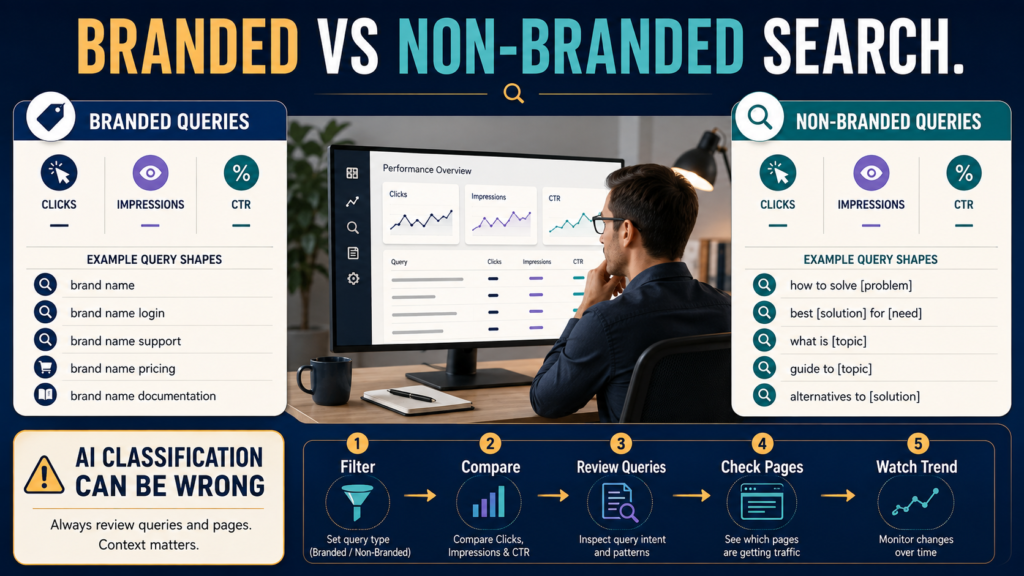
Someone searches Google for your company name.
Another person searches for:
“how to create a digital product”
and discovers you for the first time.
Both searches can generate Google Search traffic.
But they represent different relationships with the audience.
Google Search Console now includes a branded and non-branded query filter that can help separate these two kinds of search activity.
Google defines branded queries as searches containing your brand name, domain, or brand-specific products or services, including common misspellings or variations. Non-branded queries do not contain that brand identification and are usually more general.
That makes the filter useful for asking:
Are people finding us because they already know the brand—or because our content is appearing for broader topics?
But the data needs context.
Google also warns that the classification is informational, AI-assisted, and can occasionally mislabel queries.
Where to Find the Filter
Inside the Search results Performance report:
- Open the query filter.
- Select Branded or Non-branded.
- Review the resulting clicks, impressions, CTR, pages, and query data.
Google says the branded/non-branded filter works across Web, Image, Video, and News search types. It is not available for sub-properties or sites with too few impressions.
Important: The Filter Has Historical Limits
Google introduced the filter on March 11, 2025.
Its current documentation says the filter provides up to 16 months of historical data beginning from that introduction period.
That means you should not expect the automated branded classification to extend indefinitely into older Search Console history.
What Branded Search Can Tell You
Branded searches may include:
- Company name.
- Website/domain name.
- Product name strongly associated with the business.
- Common misspelling.
- Brand variation.
These searches often come from someone who already knows something about the business.
Branded traffic can therefore provide one signal of:
- Brand familiarity.
- Repeat interest.
- Word-of-mouth exposure.
- Offline or social exposure.
- Returning customer behavior.
But do not call it a perfect “brand awareness score.”
Search Console records Google Search behavior, not every way someone knows your brand.
What Non-Branded Search Can Tell You
Non-branded searches are broader.
Examples:
- best email marketing platform for beginners
- how to build a digital product
- GA4 landing page report
- affiliate marketing checklist
These visitors may have no previous knowledge of your business.
Growing non-branded visibility can therefore indicate that your content is reaching people through the topics and problems they search for—not only through your name.
Google describes non-branded search as useful for identifying new-audience growth opportunities.
Do Not Assume Branded Growth Equals SEO Growth
Suppose branded clicks increase 40%.
That may be positive.
But the cause could be:
- YouTube promotion.
- Email.
- Podcast mention.
- Paid advertising.
- Offline promotion.
- Social media.
- Customer referrals.
Google Search may simply be where people went afterward.
So a rise in branded search can indicate stronger brand demand without proving organic SEO created that demand.
Do Not Assume Non-Branded Traffic Is Automatically Better
Non-branded traffic can expose the business to new people.
But relevance matters.
Suppose you gain thousands of impressions for an unrelated query.
That is not automatically valuable growth.
Ask:
- Does the query fit the site’s subject?
- Does the visitor need what the site provides?
- Is the ranking page appropriate?
- Does the traffic lead to meaningful engagement?
Search visibility should serve the business and reader—not simply increase a chart.
Establish a Baseline
Start with an equivalent period.
For example:
Last 28 days
Record:
Branded
- Clicks.
- Impressions.
- CTR.
Non-Branded
- Clicks.
- Impressions.
- CTR.
Then compare with:
Previous 28 days.
The verified guide to comparing Search Console date ranges without misreading normal traffic changes can help you avoid comparing mismatched periods.
Review Actual Queries
Do not stop with the totals.
Open the Queries table.
Check whether Google classified obvious queries as expected.
Google explicitly says some branded/non-branded classifications may be incorrect.
If a major query appears misclassified, remember that the filter is an analytical aid—not an accounting ledger.
Example of a Classification Problem
Imagine a company named:
Bright Path
A query such as:
“bright path marketing”
could clearly be branded.
But:
“bright path to better email”
might be used generically in another context.
Automated classification can face ambiguity.
Do not base a major strategy on one questionable query.
Check Which Pages Receive Branded Traffic
Open the Pages tab after applying the branded filter.
You may find branded users reach:
- Homepage.
- Login page.
- Product page.
- About page.
- Review page.
This tells you more about what people already familiar with the brand are trying to find.
For example:
If many branded searches lead to:
[Brand] login
that is different from:
[Brand] reviews
The first reflects access/navigation.
The second reflects evaluation.
Check Which Pages Receive Non-Branded Traffic
Now apply the non-branded filter.
Look at the pages.
Which topics attract people who were not explicitly searching for your brand?
Those pages may be particularly valuable for:
- Audience growth.
- Internal linking.
- Lead generation.
- Topic expansion.
Do not immediately create more articles merely because one page has impressions.
First determine whether the queries align with the site’s purpose.
Watch Clicks and Impressions Together
Suppose:
Non-branded impressions: +30%
Non-branded clicks: +5%
That might indicate broader visibility before strong click growth.
Now ask:
- Are positions changing?
- Are new lower-ranking queries appearing?
- Is CTR changing?
- Is the site appearing for broader topics?
Do not reduce the entire story to one number.
Watch CTR Carefully
Branded queries often have higher CTR because searchers may already know the business and be specifically looking for it.
Comparing branded CTR directly with non-branded CTR can therefore be misleading.
A lower non-branded CTR does not automatically mean something is wrong.
Different intent produces different behavior.
Track the Mix Over Time
You can create a simple monthly table:
| Month | Branded Clicks | Non-Branded Clicks | Observation |
|---|---|---|---|
| June | — | — | Baseline |
| July | — | — | Non-brand growing |
| August | — | — | Brand spike after campaign |
The trend matters more than one day’s percentage.
Use the 24-Hour View for Observation, Not Brand Conclusions
If a promotion creates a sudden search spike, Search Console’s recent view can help you observe activity.
But its newest data is preliminary.
The verified Search Console 24-hour-view guide explains why very recent hourly data should not be treated as a final trend.
For brand analysis, longer periods are generally more useful.
Compare Search Appearance Separately
A branded query can also appear through different Google result features.
If you want to investigate supported result types, the verified Search Console Search Appearance guide provides a separate framework.
Do not mix:
brand classification
with:
search-result appearance
as though they measure the same thing.
Brand Search Can Reveal Reputation Questions
Branded searches may include modifiers such as:
- review
- pricing
- login
- support
- alternative
- refund
Those queries reveal different needs.
For example:
Brand + review
suggests evaluation.
Brand + login
suggests navigation.
Brand + support
suggests customer service.
Use query context, not merely the branded label.
Non-Branded Search Can Guide Content Decisions
Suppose you see growing non-branded impressions around:
digital product customer support
and several related variants.
That might indicate an opportunity to strengthen a useful topic cluster.
Before writing new content:
- Review existing coverage.
- Check the ranking page.
- Identify whether the query intent is already satisfied.
- Avoid creating near-duplicate articles.
Search data should reduce duplication, not create it.
Do Not Turn the Ratio Into a Universal Score
You might be tempted to calculate:
Non-Branded Clicks ÷ Total Clicks
and decide:
Higher is always better.
That is not universally true.
A famous brand may naturally have substantial branded search.
A new site may have almost none.
A local business may depend heavily on branded and location-based searches.
An informational site may attract mostly non-branded queries.
Context matters.
Create a Monthly Review
Once per month:
- Open Search Console Performance.
- Select a consistent date range.
- Review branded clicks and impressions.
- Review non-branded clicks and impressions.
- Check major queries.
- Check leading pages.
- Look for obvious classification problems.
- Record notable campaigns or publicity.
- Compare with the previous period.
- Choose an action only if the data supports one.
That is enough.
Conclusion
Search Console’s branded and non-branded query filter gives you a useful new way to separate people searching specifically for your brand from people finding you through broader topics.
Use it to understand:
- Brand-driven demand.
- Non-branded discovery.
- Query intent.
- Page performance.
- Changes over time.
But do not treat the classification as perfect.
Google warns that the AI-supported labeling can make mistakes, and the filter is intended for analysis rather than ranking.
Use the filter as one piece of evidence.
Then combine it with actual queries, pages, date comparisons, and business context to understand whether your search visibility is genuinely expanding.