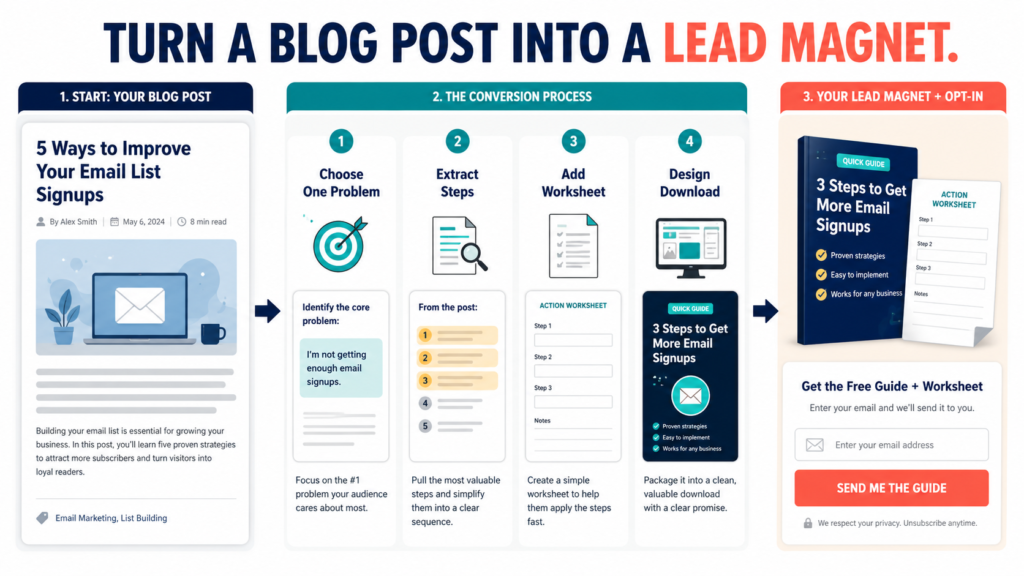
A complete blog post can provide the ideas, examples, and instructions needed for a lead magnet.
The article should not simply be copied into a PDF.
A useful lead magnet should help the reader complete one focused task, make one decision, or avoid one group of mistakes.
The best process is:
- Select a strong article.
- Identify one smaller problem.
- Extract the most useful steps.
- Add a worksheet, checklist, or template.
- Design the resource for practical use.
- Connect it to a simple signup and delivery system.
Key Takeaways
- Choose an article with a clear audience and practical steps.
- Narrow the lead magnet to one specific result.
- Add value that is not available through copying the article alone.
- Create a simple signup page and delivery email.
- Test the complete subscriber experience before promotion.
Affiliate Disclosure: This article contains affiliate links. If you purchase through one of these links, I may earn a commission at no additional cost to you. Affiliate compensation does not determine the conclusions or recommendations presented in this article.
Why Repurpose an Existing Blog Post?
A published article has already helped you:
- Research the topic
- Identify the audience question
- Organize the explanation
- Create examples
- Develop action steps
- Identify common mistakes
Using the article as source material can reduce the time required to develop a lead magnet.
It can also create a natural relationship between the public content and the subscriber resource.
The article explains the subject. The lead magnet helps the reader apply it.
Step 1: Choose the Right Article
Select an article that contains:
- One clear problem
- A specific audience
- Actionable information
- A logical sequence
- An example
- A practical next step
Good candidates include:
- How-to articles
- Checklists
- Beginner guides
- Decision guides
- Process articles
- Mistake-prevention articles
- Planning tutorials
A news article or broad opinion post may not provide enough practical material.
Step 2: Identify One Smaller Result
A lead magnet should usually be narrower than the source article.
Suppose the article is:
How to Start an Email List Before You Have a Product
Possible lead magnets include:
- The Three-Email Welcome Sequence Planner
- The Beginner Lead-Magnet Idea Worksheet
- The Email-List Setup Checklist
- The Signup-Page Copy Template
- The First 30 Days of Email Content Calendar
Each resource solves one part of the larger problem.
A focused result makes the resource easier to understand and promote.
Step 3: Select the Best Format
Checklist
Use a checklist when readers need to confirm steps.
Example:
The 15-Point Blog Publishing Checklist
Worksheet
Use a worksheet when readers need to make decisions.
Example:
The One-Page Lead-Magnet Planning Worksheet
Template
Use a template when readers need a reusable structure.
Example:
Three Welcome Email Templates for Beginners
Short Guide
Use a short guide when the reader needs explanation.
Example:
How to Choose Your First Email-Marketing Tool
Resource List
Use a resource list when the reader needs recommendations.
Example:
The Beginner Digital-Product Tool List
Choose the format that fits the task.
Step 4: Extract the Core Information
Review the article and highlight:
- The main problem
- The central answer
- The key steps
- Important cautions
- The strongest example
- The final action
Remove:
- Long introductions
- Repeated explanations
- Unnecessary background
- Sections unrelated to the lead magnet
- Promotional paragraphs
- Links that do not support the task
The lead magnet should be complete without becoming a duplicate of the article.
Step 5: Add New Practical Value
Give subscribers something that helps them apply the article.
Possible additions include:
- Fill-in-the-blank questions
- A planning page
- A scorecard
- A decision chart
- A tracking sheet
- A one-page summary
- A printable checklist
- A reusable template
- An implementation schedule
For example, an article about choosing a digital-product idea might become a worksheet asking readers to score ideas based on:
- Audience need
- Personal knowledge
- Creation time
- Cost
- Ease of delivery
- Ongoing support
- Management requirements
The worksheet makes the lead magnet more useful than a copied article.
Step 6: Create a Clear Title
The title should explain the result.
Weak title:
Free Marketing Guide
Stronger title:
The Beginner’s One-Page Lead-Magnet Planning Worksheet
The stronger title tells the visitor:
- Who it is for
- What the resource is
- What it helps plan
Avoid exaggerated phrases such as:
- Ultimate secret
- Guaranteed traffic
- Instant income
- Explosive growth
- Effortless commissions
Step 7: Develop the First Draft
Use this structure:
Title
State the practical result.
Short Introduction
Explain what the resource helps the reader do.
Instructions
Tell the reader how to use it.
Main Content
Provide the steps, questions, or template.
Example
Show one completed section.
Final Review
Help the reader check the work.
Next Action
Explain what to do after completion.
Keep the design simple enough to print or view on a screen.
Step 8: Use a Lead-Magnet Tool When Helpful
LeadMagnet IQ Commercial is positioned for creating checklists, guides, worksheets, subscriber incentives, and other lead-generation resources.
You can review the current LeadMagnet IQ Commercial offer.
A creation tool may help develop the structure or first draft. You should still review:
- Accuracy
- Originality
- Instructions
- Examples
- Branding
- Links
- Commercial-use rights
- Final formatting
Do not publish an AI-generated resource without completing a human quality review.
Step 9: Create the Signup Page
A simple signup page should include:
Headline
State what the visitor receives.
Short Explanation
Explain the problem the resource solves.
Benefits
List three to five practical results.
Form
Request only the information you need.
Privacy Language
Explain that the visitor is joining the email list.
Button
Use a clear action such as:
- Send Me the Checklist
- Get the Planning Worksheet
- Download the Guide
Avoid vague buttons such as “Submit.”
Step 10: Write the Delivery Email
The first email should:
- Welcome the subscriber.
- Provide the resource.
- Explain how to use it.
- Recommend one first action.
- Explain what future messages will contain.
- Include an unsubscribe option through the email service.
Do not hide the promised download beneath a long sales message.
Step 11: Create a Short Welcome Sequence
A three-message sequence can be enough.
Email 1: Deliver
Provide the resource.
Email 2: Teach
Explain one common problem related to the resource.
Email 3: Engage
Ask what the subscriber needs help with next.
The replies can help identify future articles, products, and lead magnets.
Step 12: Connect the Funnel
GetResponse provides tools for email marketing, landing pages, forms, and automation. Its current landing-page information describes customizable templates, mobile-friendly pages, and a drag-and-drop editor.
You can explore GetResponse’s email-marketing and landing-page features.
The complete path should be:
- Visitor reads the article.
- Visitor sees the lead-magnet offer.
- Visitor opens the signup page.
- Visitor submits the form.
- Delivery email arrives.
- Resource opens correctly.
- Welcome sequence begins.
Test the complete path yourself.
A Practical Blog-to-Lead-Magnet Example
Source Article
How to Review AI-Generated Content Before Publishing
Smaller Problem
Beginners forget important review steps.
Lead Magnet
The Beginner’s AI Content Quality-Control Checklist
Added Value
- Accuracy checklist
- Repetition check
- Missing-step review
- Affiliate-link review
- Final publishing check
- Space for notes
Signup-Page Promise
Review your next AI-generated article with a practical checklist covering accuracy, clarity, usefulness, and publication readiness.
The article teaches the process. The lead magnet helps the reader perform it repeatedly.
Disclosure and Trust
The FTC’s endorsement guidance explains that material connections should be disclosed clearly when recommendations may financially benefit the publisher.
When the lead magnet or follow-up emails contain affiliate links:
- Include a clear disclosure.
- Place it before the first affiliate recommendation.
- Use understandable language.
- Avoid hiding the disclosure in a footer.
Transparency supports reader trust.
Common Lead-Magnet Mistakes
Copying the Article Into a PDF
A lead magnet should provide a practical application or focused result.
Making It Too Long
A useful five-page worksheet may be better than a 50-page guide.
Choosing a Vague Title
Tell the visitor exactly what the resource provides.
Requiring Too Much Information
A long signup form can discourage completion.
Failing to Test Delivery
Confirm that the email arrives and the file opens.
Creating a Resource Unrelated to the Article
The offer should be a natural next step.
Lead-Magnet Quality-Control Checklist
Content
- Does it solve one problem?
- Are the instructions clear?
- Is an example included?
- Is the final action obvious?
Design
- Is the text readable?
- Can the resource be printed?
- Does it display correctly on mobile?
- Is the branding consistent?
Accuracy
- Are facts verified?
- Do links work?
- Are claims realistic?
- Is the disclosure included when needed?
Delivery
- Does the form work?
- Does the email arrive?
- Does the download open?
- Can the subscriber unsubscribe?
Conclusion
A blog post can become a valuable lead magnet when the information is narrowed, reorganized, and turned into a practical resource.
Choose one useful article, identify one smaller result, select the right format, add a worksheet or checklist, and test the complete signup and delivery process.
Review one existing article and write down the single task a reader could complete with a companion lead magnet.