Publishing an article does not guarantee that people will see it.
A useful article may remain unnoticed if it is never shared, mentioned in email, adapted for social media, or connected to other marketing activities.
Many small-business owners spend most of their time creating content and very little time promoting it. They publish an article, share the link once, and immediately begin working on the next topic.
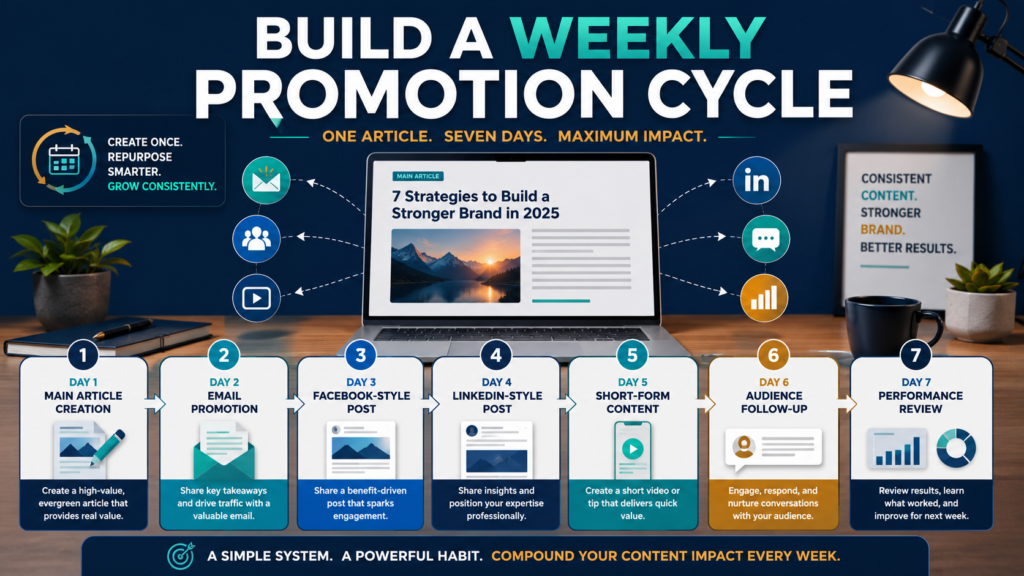
A repeatable weekly promotion cycle helps you receive more value from every piece of content without relying on random daily decisions.
Affiliate Disclosure: This article contains affiliate links. I may earn a commission if you purchase through one of these links, at no additional cost to you.
Begin With One Primary Article
Choose one article as the main content asset for the week.
The article should address a clear audience problem and provide a complete explanation.
For example:
“How to Create a Simple Beginner Email Welcome Sequence.”
The article can become the source for several promotional messages.
Identify:
- The main problem.
- The strongest lesson.
- One useful example.
- One common mistake.
- One practical action.
- One related resource.
These elements can be adapted into different messages throughout the week.
Monday: Publish and Verify
Publish the article and review the live page.
Confirm that:
- The title displays correctly.
- The featured image loads.
- Headings are formatted properly.
- Links work.
- The affiliate disclosure is visible.
- The call to action is connected to the topic.
- The page works on a mobile device.
Do not begin promotion until the page is ready for visitors.
Tuesday: Share a Facebook Lesson
Create a Facebook post based on one lesson from the article.
Do not paste the entire introduction.
Use a conversational format:
- Identify the problem.
- Explain one useful point.
- Ask a relevant question.
- Direct interested readers toward the complete article or resource.
The Facebook post should provide value even when the reader does not click immediately.
This approach builds trust while creating a natural reason to learn more.
Wednesday: Send an Email
Send subscribers a short educational email connected to the article.
The email might include:
- A personal observation.
- A mistake beginners commonly make.
- A short story.
- A practical exercise.
- An example not included in the article.
Then direct readers to the full article.
GetResponse can help manage subscriber lists, create newsletters, build landing pages, and automate follow-up messages.
https://links.linkcontroller.com/mikeslinks/getresponse
Email allows you to reach an audience directly instead of depending entirely on social-media distribution.
Thursday: Create a LinkedIn Perspective
LinkedIn readers may respond to a more professional interpretation of the topic.
Connect the lesson to:
- Productivity.
- Communication.
- Leadership.
- Marketing strategy.
- Business systems.
- Customer experience.
- Decision-making.
For example, an article about email welcome sequences could become a LinkedIn post about the importance of setting clear expectations during the first stage of a business relationship.
The core topic remains consistent, but the presentation matches the platform.
Friday: Promote a Supporting Resource
Use the article to introduce a helpful checklist, guide, template, or lead magnet.
A good supporting resource helps the reader apply the lesson.
LeadMagnet IQ can assist with developing focused lead-magnet ideas and commercially usable resources.
https://links.linkcontroller.com/mikeslinks/leadmagnetiq
The tool may be helpful when you need to turn a broad article topic into a practical downloadable asset. Review and personalize the material so it reflects your audience and expertise.
Saturday: Repurpose a Specific Section
Return to the article and select one section that can stand alone.
Turn it into:
- A checklist.
- A short tutorial.
- A question-and-answer post.
- A quick-reference graphic.
- A short email.
- A list of mistakes.
- A brief case example.
Avoid summarizing the entire article again.
A focused section creates a fresh reason to discuss the topic.
Sunday: Review Performance
At the end of the cycle, review the results.
Look at:
- Article visits.
- Email opens.
- Email clicks.
- Social engagement.
- Subscriber growth.
- Affiliate-link clicks.
- Reader questions.
- Comments and replies.
Do not evaluate the article only by immediate sales.
Some content builds awareness, answers objections, attracts subscribers, or supports a purchase that occurs later.
Record what you learned and use that information when planning the next week.
Use One Central Message
The promotion cycle should reinforce one main message.
If the article teaches beginners to build a short welcome sequence, every supporting item should remain connected to that lesson.
Avoid using the week to promote several unrelated products.
A focused message is easier for the audience to remember.
It also makes the promotional process easier because you are adapting one idea instead of creating a different campaign every day.
Prepare Assets in Advance
Before the week begins, prepare:
- The article.
- Featured image.
- Facebook post.
- LinkedIn post.
- Subscriber email.
- Supporting resource.
- Affiliate recommendation.
- Tracking links.
- Publishing schedule.
Batch preparation reduces daily pressure.
You can still respond to current events or audience questions, but the core promotion system remains ready.
Keep the Cycle Manageable
You do not need to use every platform.
A smaller cycle might include:
- One article.
- One email.
- Two social posts.
- One follow-up message.
- One performance review.
Choose the activities you can maintain consistently.
A simple system completed every week is more valuable than a complicated plan that is abandoned after several days.
Conclusion
Content creation and content promotion should work together.
A repeatable weekly cycle allows one valuable article to support email marketing, social-media education, audience growth, affiliate recommendations, and future content ideas.
Instead of publishing and immediately moving on, give each article several opportunities to reach the people it was created to help.
Select one completed article today and schedule three additional ways to share its most useful lessons during the coming week.
#ContentPromotion, #DigitalMarketing, #EmailMarketing, #SocialMediaStrategy, #BlogTraffic, #OnlineBusiness