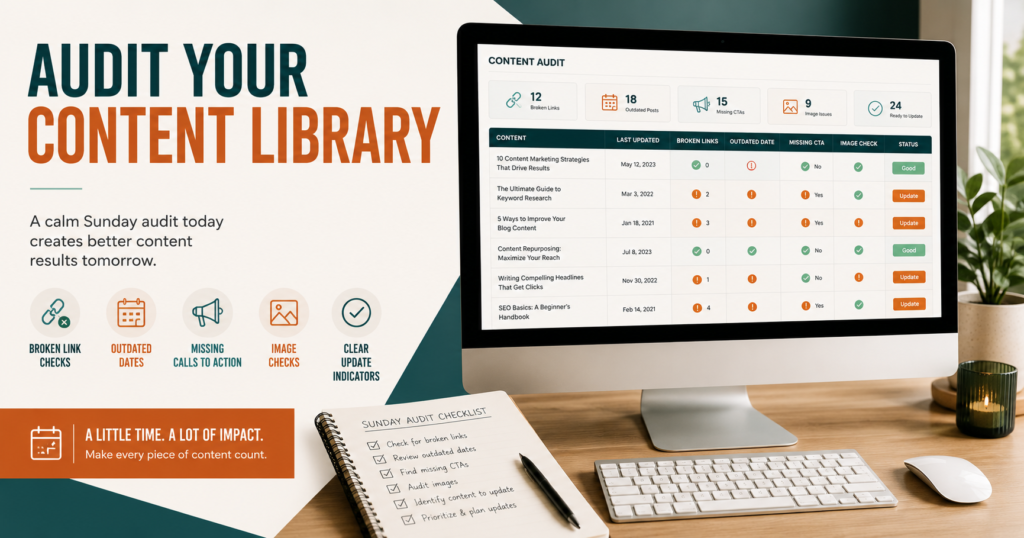
Publishing a blog article is not the final step in content marketing.
Over time, links change, recommendations become outdated, images disappear, product names are updated, calls to action become less relevant, and older articles may no longer reflect your current business direction.
A website content audit helps you identify these problems before they damage the reader’s experience.
You do not need to review every page in one day. A simple Sunday audit can focus on a small group of articles each week. This creates a manageable maintenance routine that gradually improves the entire website.
Affiliate Disclosure: This article contains affiliate links. If you purchase through one of these links, I may receive a commission at no additional cost to you.
Choose a Small Group of Articles
Begin by selecting five to ten articles.
You can choose them based on:
- Publication date.
- Website traffic.
- Affiliate-link activity.
- Search visibility.
- Topic importance.
- Recent product changes.
- Articles connected to current promotions.
Starting with a small group prevents the audit from becoming overwhelming.
Create a simple tracking sheet containing the article title, URL, publication date, review status, required changes, and completion date.
Review the Main Topic
Open each article and confirm that the content still matches the title.
Over time, articles may become unfocused because new sections were added without reviewing the overall structure.
Ask:
- Does the introduction clearly explain the problem?
- Does every section support the main topic?
- Are important steps missing?
- Does the article answer the question promised by the title?
- Is the conclusion connected to the article?
Remove unrelated material or move it into a separate article.
Focused content is easier to read and easier to promote.
Check Facts, Dates, and Product Information
Review all information that may have changed.
This includes:
- Product names.
- Software features.
- Pricing statements.
- Trial information.
- Company policies.
- Platform instructions.
- Statistics.
- Dates.
- Screenshots.
- Affiliate disclosures.
Avoid presenting old information as current.
When you cannot verify a detail, replace it with a more durable explanation or clearly tell the reader to review the provider’s current information.
Evergreen content still requires occasional maintenance.
Test Every Link
Click every link in the article.
Confirm that:
- The page opens.
- The destination is correct.
- The affiliate tracking is working.
- The link uses a secure address.
- The recommended tool still exists.
- The linked resource matches the surrounding explanation.
Broken or incorrect links create frustration and may reduce affiliate commissions.
If you have a large website, begin with your most visited or highest-value articles.
A tool such as SpinRewriter may help create updated wording when you own the original article and need to refresh outdated sections.
https://links.linkcontroller.com/mikeslinks/spinrewriter
Use rewriting assistance carefully. Review every revised paragraph to make sure the meaning remains accurate and the content sounds natural.
Evaluate Affiliate Recommendations
An affiliate link should not appear without context.
Review whether the article explains:
- What the tool does.
- Who may benefit from it.
- How it relates to the topic.
- Any important limitations.
- Why the reader may want to review it.
Remove affiliate links that no longer support the article.
A smaller number of relevant recommendations is often more useful than a long list of unrelated tools.
Also confirm that the affiliate disclosure is visible and understandable.
Review Images
Check the featured image and any supporting graphics.
Look for:
- Missing images.
- Blurry graphics.
- Outdated screenshots.
- Incorrect dimensions.
- Unreadable text.
- Missing alternative text.
- Images that do not match the topic.
A strong image should reinforce the main lesson rather than merely decorate the page.
ClickDesigns can help create blog graphics, social-media visuals, product covers, and lead-magnet images.
https://links.linkcontroller.com/mikeslinks/clickdesigns
It may be useful when an older article needs a clearer featured image or a visual that better matches your current branding.
Strengthen the Introduction
Readers often decide quickly whether an article is relevant.
The opening should identify:
- The audience problem.
- Why the problem matters.
- What the article will help the reader accomplish.
Remove long introductions that delay the main lesson.
Avoid exaggerated promises. A clear explanation of a practical benefit is usually stronger than hype.
Improve the Call to Action
Every article should guide the reader toward a reasonable next step.
Possible next actions include:
- Download a free resource.
- Join the email list.
- Read a related article.
- Review an affiliate tool.
- Reply with a question.
- Complete a specific exercise.
The next step should be connected to the article.
An article about email-list building might invite the reader to download a subscriber checklist. It should not suddenly promote an unrelated graphic-design product.
Review Readability
Break long paragraphs into shorter sections.
Add useful headings where necessary.
Define unfamiliar terms.
Replace vague instructions with specific actions.
For example, “promote your content regularly” is broad.
A clearer instruction would be:
“Share the article on Facebook on Monday, include one lesson in Wednesday’s email, and publish a related LinkedIn post on Friday.”
Specific instructions make content more actionable.
Record Future Content Ideas
An audit often reveals new article opportunities.
You may discover:
- A section that deserves a complete tutorial.
- A product that needs a current review.
- A repeated reader question.
- A missing comparison.
- A topic that needs a beginner version.
- An outdated article that should be replaced.
Record these ideas in your editorial calendar.
This allows website maintenance to support future content creation.
Create a Repeatable Audit Checklist
Use the same review process each week:
- Select five to ten articles.
- Review the topic and structure.
- Verify facts and dates.
- Test links.
- Evaluate affiliate recommendations.
- Review images.
- Strengthen the introduction.
- Improve the next step.
- Check readability.
- Record new ideas.
A repeatable process makes website improvement easier to maintain.
Conclusion
A website content audit protects the value of work you have already completed.
Instead of allowing old articles to become inaccurate or disconnected from your business, you can gradually improve them through short weekly reviews.
Each updated article becomes easier to trust, easier to promote, and more useful to the reader.
Choose five existing articles today, test every link, review every recommendation, and record the specific changes needed to bring each page up to your current standard.
#ContentAudit, #WebsiteMaintenance, #BloggingTips, #AffiliateMarketing, #ContentMarketing, #OnlineBusiness