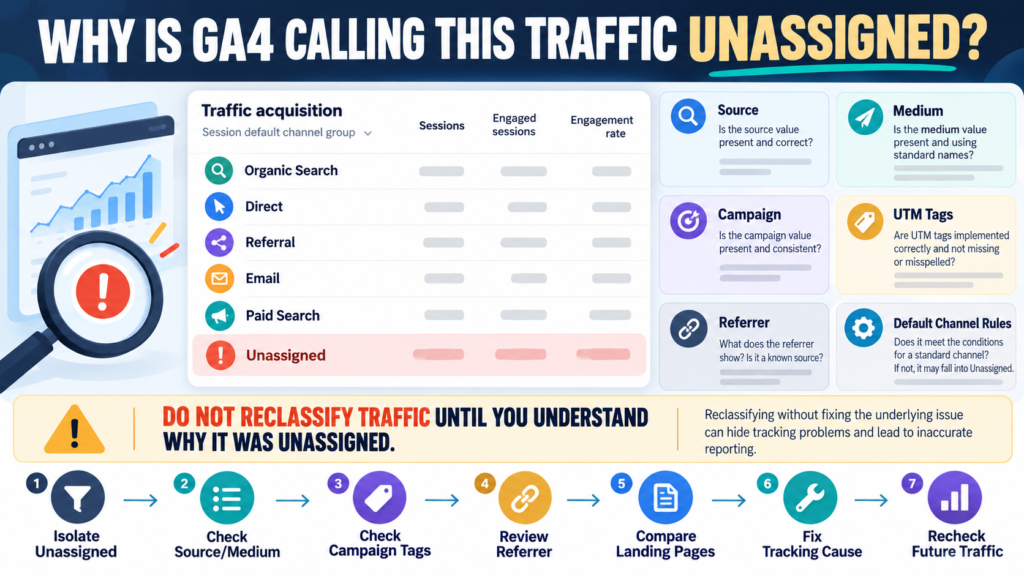
You open GA4’s Traffic Acquisition report and see:
Unassigned
That can be frustrating.
Where did those visitors come from?
Did Google lose the traffic source?
Is your tracking broken?
Should you create a custom channel just to make the row disappear?
Not so fast.
Google currently defines Unassigned as the default-channel-group value used when the available event data does not match any of the channel rules Google applies.
That makes Unassigned a diagnostic clue.
The useful workflow is:
Isolate Unassigned → Inspect Source/Medium → Inspect Campaign Data → Check Tagging → Identify Cause → Fix Future Collection
What Unassigned Means
GA4’s default channel group uses rules to classify traffic into categories such as:
- Organic Search.
- Paid Search.
- Email.
- Referral.
- Affiliates.
- Organic Social.
- Paid Social.
- Direct.
If traffic-source data does not match one of Google’s current channel definitions:
GA4 can classify it as:
Unassigned.
The goal is therefore not to rename the traffic immediately.
The goal is to understand why the rule could not classify it.
Start With Traffic Acquisition
Open:
Reports → Acquisition → Traffic Acquisition
Use:
Session default channel group
because your question is about how sessions arrived.
Then filter or compare:
Unassigned
Now you can investigate that subset instead of looking at the entire website.
Add Session Source / Medium
The most useful next dimension is often:
Session source / medium
Examples might look like:
newsletter / email
google / organic
partner / referral
If Unassigned rows contain strange source/medium values:
That may immediately reveal the problem.
“(not set)” Can Create Unassigned Traffic
Google specifically documents that when session source / medium is (not set), the traffic can appear as Unassigned because there is no value matching a default-channel rule.
Therefore:
If you see:
(not set) / (not set)
do not begin by editing channel groups.
Investigate why valid session-source information was not available.
Check Manual UTM Parameters
A common source of classification problems is inconsistent campaign tagging.
For example:
Correct:
utm_medium=email
Problematic custom value:
utm_medium=weekly-news-blast
Google’s default Email rule expects recognized source or medium patterns.
A custom medium can fail to match the intended channel.
Your verified UTM Parameters in GA4 guide explains why consistent campaign naming matters.
Use Recognizable Medium Values
Common examples include:
cpc
paid_social
affiliate
referral
Do not invent a different medium for every campaign just because the value sounds descriptive.
Use:
utm_campaign
for the descriptive campaign name.
Use:
utm_medium
for the traffic type.
Example
Weak tagging:
utm_source=newsletter
utm_medium=september-special-sale
Better:
utm_source=newsletter
utm_medium=email
utm_campaign=september-special-sale
Now the medium describes the channel.
The campaign describes the individual promotion.
Check Landing Pages
Add:
Landing page + query string
or another appropriate landing-page dimension.
Ask:
Where is the Unassigned traffic arriving?
If most of it reaches one campaign page:
That gives you another clue.
Perhaps a campaign link on that page used unusual tagging.
Check the Referrer
Some traffic may arrive through:
- Redirects.
- Apps.
- Shared links.
- Payment platforms.
- Authentication services.
Referrer behavior can affect source attribution.
Look for patterns rather than trying to classify every individual visit manually.
Compare With Session Source / Medium, Not First User Source
This distinction matters.
Your verified GA4 User Acquisition vs Traffic Acquisition guide explains that:
First-user dimensions
describe how the user was originally acquired.
Session dimensions
describe the current session.
If you are troubleshooting a row in Traffic Acquisition:
Use the session-scoped information.
Do Not Assume Unassigned Equals Direct
Direct means GA4 could not identify another referrer or campaign under the relevant rules.
Unassigned means:
The available data did not match another default-channel classification.
They are not interchangeable.
Do not simply convert all Unassigned traffic into Direct.
Default Channel Groups Cannot Be Edited
Google currently says its default channel group cannot be edited. You can create custom channel groups, and eligible properties can use a custom group as a primary group, but Google’s original default remains available as a reference.
This is useful.
It means you can create your own reporting structure without erasing Google’s standard classification.
Do Not Create a Custom Channel Merely to Hide the Problem
Suppose bad campaign tagging produces:
Unassigned
You could create:
My Custom Email Channel
with a rule matching the bad medium.
That might make the report look cleaner.
But the underlying tagging remains inconsistent.
Fix collection first when practical.
Custom Channels Are Useful for Legitimate Business Categories
Custom channel groups make sense when you intentionally want reporting that differs from Google’s default structure.
Examples:
- Partner Newsletter.
- AI Referral.
- Influencer Traffic.
- Internal Promotion.
Google allows rule-based custom channel groups for supported acquisition reporting.
Use them because the business needs a different classification—not because an error needs to be hidden.
Check Whether Unassigned Is Large Enough to Matter
Suppose:
Unassigned = 7 sessions
out of:
25,000 total sessions
That may not deserve hours of investigation.
Compare:
Unassigned = 25% of sessions
Now the issue deserves attention.
Always examine volume.
Look for a Sudden Starting Date
Compare dates.
If Unassigned traffic was:
Near zero until September 15
then suddenly increased:
Ask:
What changed around September 15?
Possibilities:
- New email campaign.
- New paid traffic.
- Website redirect.
- New checkout.
- Tagging change.
- Integration change.
Your business change records can help identify the event.
Segment by Campaign
If a manual campaign is causing the issue:
Filtering by campaign may expose it quickly.
Example:
Campaign: fall_launch
Source/medium:
email-list / fall-promo
If the medium is unusual:
You found a likely cause.
Fix Future Data Rather Than Rewriting History
GA4 generally does not transform all old incorrectly tagged sessions simply because you correct future campaign URLs.
Think of the fix as:
From this point forward, use clean tags.
Record the change date.
Then compare future data separately.
Build a UTM Naming Standard
Example:
SOURCE
newsletter
youtube
partnername
MEDIUM
email
social
referral
affiliate
CAMPAIGN
ai_starter_kit
september_launch
holiday_sale
The standard reduces future Unassigned traffic and reporting fragmentation.
A Simple Unassigned Troubleshooting Worksheet
Record:
Date Range:
Unassigned Sessions:
Percent of Total Sessions:
Session Source / Medium:
Campaign:
Landing Page:
Referrer Pattern:
UTM Problem?:
Tracking Problem?:
Custom Channel Needed?:
Fix:
Change Date:
Conclusion
GA4 Unassigned traffic does not automatically mean your analytics installation is broken.
Google uses Unassigned when traffic information does not match an applicable default-channel rule.
Start with:
Session Source / Medium → Campaign → UTM Tags → Landing Page → Referrer
Then determine whether the cause is:
- Missing source information.
- Inconsistent manual tagging.
- An unusual traffic source.
- A legitimate custom classification need.
Do not rewrite your channel strategy merely to make the word:
Unassigned
disappear.
Your Next Action
Open:
GA4 → Traffic Acquisition
Filter to:
Session Default Channel Group = Unassigned
Then add:
Session Source / Medium
Record the top five rows.
For each one ask:
Does the medium use a recognized value such as email, referral, affiliate, or paid campaign tagging?
If you find inconsistent UTM values:
Fix one future campaign template today.
Do not change five analytics settings at once.
Correct the source of the classification problem first, then compare future Unassigned traffic after the new tagging has been used.