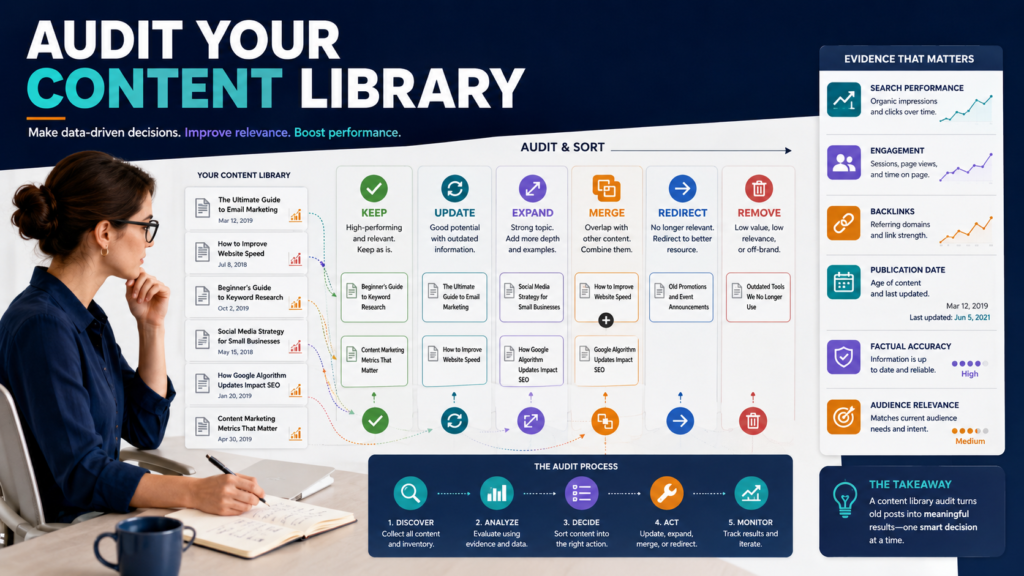
A content audit should help you decide what each existing page deserves next.
That does not mean deleting everything with low traffic.
An older article may still:
- Answer an important niche question.
- Attract backlinks.
- Support another article.
- Help existing customers.
- Convert visitors.
- Serve a seasonal need.
- Need only a factual update.
A practical content audit evaluates every important page using purpose, quality, accuracy, performance, overlap, and current relevance before choosing an action.
The available actions are usually:
Keep → Update → Expand → Merge → Redirect → Remove.
Google’s current people-first guidance explicitly encourages site owners experiencing declines to examine which pages were most affected and assess whether those pages provide original, substantial, complete, and genuinely useful information.
Key Takeaways
- Do not delete pages simply because traffic is low.
- Define the purpose of each article.
- Review Search Console and analytics data.
- Check factual accuracy and outdated references.
- Identify articles serving the same intent.
- Improve pages with clear value.
- Merge overlapping pages when one stronger resource would serve readers better.
- Use redirects appropriately when retiring URLs.
- Preserve pages that still perform an important job.
Start With a Content Inventory
Create a spreadsheet.
Record:
- URL.
- Article title.
- Category.
- Publication date.
- Last updated date.
- Primary topic.
- Purpose.
- Search clicks.
- Search impressions.
- Engagement.
- Key events.
- Backlinks where available.
- Internal links.
- Accuracy status.
- Recommended action.
Do not try to remember a site with hundreds of articles.
Inventory first.
Define What Each Page Is Supposed to Do
Possible jobs include:
Attract Search Traffic
Educational guide.
Support Existing Customers
Help article.
Generate Leads
Lead-magnet article.
Support Buying Decisions
Product review.
Build Authority
Detailed research or framework.
Support Another Page
Cluster or prerequisite content.
You cannot judge an article until you know its purpose.
Review Search Performance
Use Search Console.
For each important page, look at:
- Clicks.
- Impressions.
- Queries.
- Position trends.
Ask:
- Does it still appear in Search?
- For which questions?
- Did traffic decline?
- Is the page attracting unexpected queries?
- Does a different page compete for the same searches?
Search Console is designed to show how a site performs in Search across queries and pages.
Review On-Site Behavior
Use GA4 or another analytics system.
Look at:
- Sessions.
- Engagement.
- Key events.
- Traffic source.
- Landing-page activity.
Google explains that Search Console and Analytics measure different stages of the user journey, so using both provides a more complete picture.
An article with modest Search traffic may still generate useful subscriber activity.
Check Accuracy
Open the article.
Highlight:
- Prices.
- Product features.
- Dates.
- Statistics.
- Screenshots.
- Platform rules.
- Laws.
- Software instructions.
- Links.
Classify:
Current
No meaningful factual problem.
Needs Minor Update
A few links or details changed.
Substantially Outdated
Core advice no longer matches reality.
Do not preserve inaccurate information merely because the article once ranked.
Check the Search Intent
Suppose the page is:
Best Facebook Marketing Tips 2019
Ask:
- Do people still want this information?
- Has terminology changed?
- Is the current search intent different?
- Does the title need reframing?
The subject may still be useful even if the presentation is old.
Identify Content Overlap
Search your site for the same topic.
You may find:
- How to Create a Lead Magnet.
- Lead Magnet Creation Guide.
- Beginner Lead Magnet Tips.
- How to Build Your First Lead Magnet.
If these articles answer essentially the same question, separate URLs may no longer be useful.
Read them.
Do not decide from titles alone.
Decision 1: Keep
Keep an article when it is:
- Accurate.
- Useful.
- Distinct.
- Relevant.
- Performing its intended job.
Do not rewrite it simply because you are conducting an audit.
A content audit should reduce unnecessary work.
Decision 2: Update
Update when the core article is still strong but details changed.
Possible updates:
- New price.
- Current screenshot.
- Broken links.
- Removed product feature.
- Better example.
- New section.
- More direct introduction.
Record the update date.
Decision 3: Expand
Expand when the article answers the right question but incompletely.
Suppose a page explains:
How to Start an Email List
but lacks:
- Lead magnet.
- Welcome sequence.
- Consent.
- Measurement.
If those subjects are necessary to answer the main question, add them.
Google’s people-first self-assessment asks whether content provides a substantial and complete treatment of its topic.
Decision 4: Merge
Merge when several weak pages serve the same intent.
Process:
- Select the strongest destination URL.
- Gather unique useful material.
- Remove repetition.
- Update facts.
- Publish one complete resource.
- Redirect retired URLs when appropriate.
- Update internal links.
Google documents permanent redirects as a way to signal that a resource has moved to a new location.
Do not merge unrelated articles solely because they share a broad keyword.
Decision 5: Redirect
Use a redirect when:
- A page has a clear replacement.
- Two articles were consolidated.
- A URL changed.
- A product page moved.
Redirect to the closest relevant destination.
Do not redirect every deleted article to the home page.
The replacement should make sense for the reader.
Decision 6: Remove
Removal may be appropriate when content is:
- Inaccurate.
- Irrelevant.
- Extremely thin.
- Duplicative.
- Unsupported.
- No longer useful.
- Not worth updating.
- Without a suitable replacement.
Before removing:
- Check backlinks.
- Check internal links.
- Check traffic.
- Check conversions.
- Check whether another page replaces it.
Deletion should be deliberate.
Do Not Use Traffic Alone
Consider:
Page A
20 visits per month.
But it answers a narrow support question and prevents customer emails.
Keep.
Page B
2,000 visits per month.
But it discusses a product you no longer recommend and contains outdated pricing.
Update immediately.
Traffic is one input.
Evaluate Original Value
Google’s current Search guidance asks whether content provides original information, analysis, or value beyond simply copying or rewriting other sources.
For each page ask:
- Does this contain original examples?
- Useful workflow?
- Decision framework?
- Real explanation?
- Current verification?
- Practical action?
If not, decide whether it can be improved.
Audit for Commodity Content
Google’s newer 2026 guidance for generative AI search emphasizes developing non-commodity content that provides unique, expert-led value rather than relying on special AI-search tricks.
Generic article:
7 Tips for Better Email Marketing
Improved article:
How to Diagnose Why New Subscribers Are Not Clicking Your Welcome Emails
The second addresses a defined problem.
During the audit, identify pages that need more specific purpose.
Check for Scaled Low-Value Content
Google’s spam policies define scaled content abuse around producing many pages primarily to manipulate rankings rather than help users, regardless of whether the content was created by automation, humans, or a combination.
A large content library should therefore be reviewed for:
- Repetitive pages.
- Minor keyword variations.
- Thin summaries.
- Mass-produced low-value articles.
The solution is not automatically deleting everything created with AI.
The solution is evaluating usefulness.
Check Internal Links
For every page:
- What links to it?
- What does it link to?
- Are destinations current?
- Are important newer resources missing?
- Does it link to retired pages?
An audit is an excellent opportunity to improve navigation.
Check Images
Review:
- Featured image.
- Screenshots.
- ALT text.
- Broken image files.
- Old software interfaces.
- Tiny text.
- Outdated branding.
You do not have to replace every old image.
Replace images when they make the article misleading or difficult to use.
Prioritize the Audit
Do not begin with 1,000 URLs.
Start with:
Tier 1
Pages with meaningful traffic.
Tier 2
Pages supporting products or lead generation.
Tier 3
Pages with recent traffic declines.
Tier 4
Low-value or overlapping content.
Complete the highest-impact work first.
A Practical Audit Example
Suppose a marketing website has four articles:
Article 1
“GetResponse Review 2023”
Still receives traffic.
Action:
Update.
Article 2
“How to Create a Welcome Series”
Current and useful.
Action:
Keep.
Article 3
“5 Welcome Email Tips”
Substantially overlaps Article 2.
Action:
Merge.
Article 4
“Old Software X Review”
Product discontinued, no traffic, no backlinks.
Action:
Possibly remove.
Different pages deserve different treatment.
Create an Audit Decision Note
For each page record one sentence:
Keep: Current, unique tutorial with steady engagement.
Update: Strong search traffic but outdated pricing.
Merge: Same intent as primary guide.
Remove: Obsolete product with no useful replacement.
This makes the audit understandable later.
Recheck Results
After major updates:
- Watch Search Console.
- Watch engagement.
- Check redirects.
- Check errors.
- Review key pages.
Do not expect every change to create immediate ranking gains.
Google notes that significant content improvements may take time to be reassessed by its systems.
Common Content-Audit Mistakes
Deleting every low-traffic page
Low traffic does not equal no value.
Updating every date
Make meaningful changes.
Merging unrelated content
Intent must match.
Keeping inaccurate reviews because they rank
Update readers first.
Ignoring redirects
Retired URLs may need appropriate destinations.
Auditing without analytics
Use evidence.
Trying to finish the whole site in one day
Prioritize.
Conclusion
A content audit is a decision system, not a mass-deletion exercise.
Review each page according to its purpose, accuracy, Search performance, engagement, overlap, links, and present-day audience value.
Then choose the correct action:
Keep, Update, Expand, Merge, Redirect, or Remove.
Google’s current guidance supports evaluating affected pages for originality, completeness, usefulness, and people-first value rather than chasing superficial signals.
Begin with your twenty most important existing articles and assign each one of the six audit decisions before creating another large batch of replacement content.