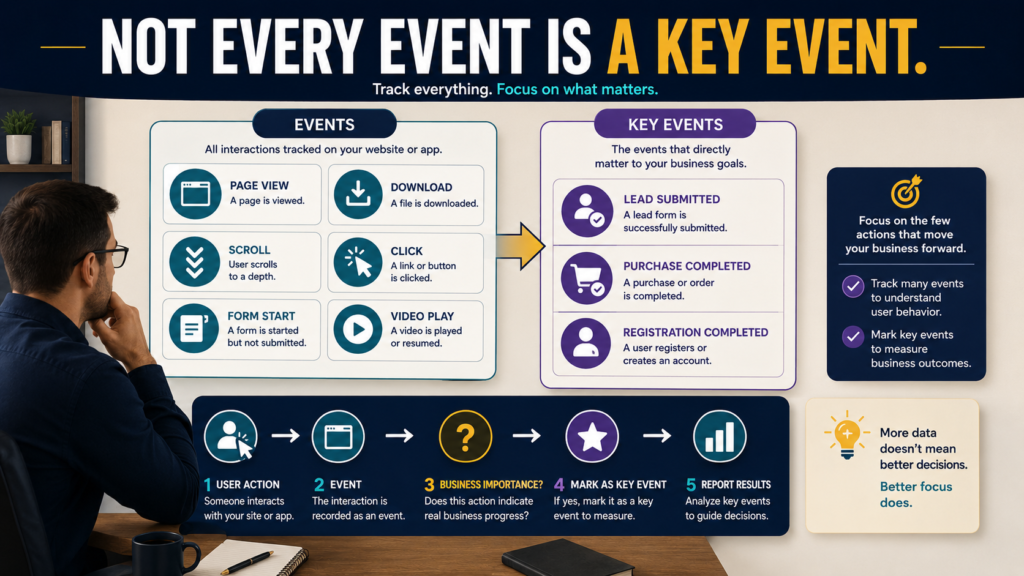
Google Analytics 4 records website and app activity through events.
A page view is an event.
A session starting is an event.
A file download can be an event.
A form submission can be an event.
But that does not mean every event is equally important.
GA4 uses key events for actions that are especially important to the success of the business.
Google defines a key event as an event measuring an action that is particularly important to business success. Any collected event can potentially be marked as a key event.
The simplest distinction is:
Event = Something happened.
Key event = Something important to the business happened.
That difference helps prevent one of the most common analytics mistakes:
marking too many actions as conversions simply because they can be tracked.
All Key Events Begin as Events
Google’s current model is:
Event → Key Event
You first need an event that represents the action.
Then, when that action matters to the business, it can be marked as a key event.
Suppose your lead-magnet form generates:
generate_lead
You can decide that a completed lead submission is important.
Mark it as a key event.
Now GA4 can use that action in reporting focused on meaningful business outcomes.
Not Every Page View Should Be a Key Event
Imagine marking the standard page_view event as a key event.
Every page viewed across the website would then count.
That is usually not what you want.
Google’s documentation gives a similar example: if you want to measure visits to a confirmation page, simply marking every page_view as a key event would be too broad. Instead, you can create a more specific event based on the relevant page-view condition and mark that specific event as important.
This illustrates a good measurement principle:
Track the exact outcome rather than using a broad event that happens everywhere.
What Is an Event?
Events represent interactions or occurrences.
Depending on your GA4 configuration, events may include:
- Page views.
- Session starts.
- Scrolls.
- File downloads.
- Video activity.
- Outbound clicks.
- Form activity.
- Purchases.
- Custom business actions.
Some are automatically collected.
Some come from enhanced measurement.
Some need implementation.
Some may be created from existing events.
The fact that an event appears in GA4 does not mean you should optimize the business around it.
What Is a Key Event?
A key event is your declaration that:
“This particular action matters enough to be measured as a business result.”
Examples might include:
Lead-Generation Site
Completed email signup.
Ecommerce Site
Completed purchase.
Course Site
Completed registration.
Service Business
Qualified consultation form submitted.
Membership Business
Membership signup.
The correct key events depend on the site’s purpose.
Start With Business Goals
Do not begin inside GA4.
Start with:
What does this website need visitors to do?
For example:
A content website may want to:
- Attract the correct visitor.
- Help them.
- Encourage them to subscribe.
- Lead qualified subscribers toward an appropriate product.
Potential key events might include:
- Lead submission.
- Purchase.
Not:
- Every scroll.
- Every page view.
- Every click.
Event Does Not Mean Success
A visitor clicking a button can be useful information.
It does not necessarily mean the intended outcome happened.
Suppose:
Button click → opens signup form → visitor abandons form.
If you mark the button click as the key event, you may count an incomplete action as success.
Whenever possible, measure the completed result.
For example:
Form successfully submitted
rather than:
Form button clicked.
Create an Event When the Existing One Is Too Broad
Google allows events to be created from existing events.
Its documentation explains the difference between:
Modify: change the existing event.
Create: generate a new event from an existing event while preserving the original.
This can be useful for a thank-you page.
Suppose the normal page-view event fires throughout your website.
You might create a more specific event for:
page_view where page_location contains /thank-you/
Then mark that event as a key event if reaching the page reliably represents the desired completed action.
Be Careful With Thank-You Pages
A thank-you-page event is only as accurate as the page’s behavior.
Ask:
- Can someone reload it?
- Can it be visited directly?
- Can someone bookmark it?
- Can the same user trigger it repeatedly?
- Does every successful completion reach it?
Where possible, use the most reliable event your implementation supports.
The analytics interface cannot correct a poorly designed measurement setup.
Example: Lead Magnet Website
Possible events:
page_viewscrollclickform_startgenerate_lead
Which might be the key event?
generate_lead
because that represents the intended business result.
The earlier events are still useful for diagnosing why people did or did not complete the process.
Example: Affiliate Review Site
Possible events:
- Review viewed.
- Scroll.
- Internal link clicked.
- Affiliate offer clicked.
An outbound affiliate click might be an important intermediate action.
Whether you designate it as a key event depends on what you are trying to measure.
Remember:
Affiliate click ≠ sale.
If you cannot observe the final sale inside GA4, label the metric accurately.
Do not report:
Conversions = sales
when the measured action is only:
outbound clicks.
Example: Digital-Product Seller
Possible key events might include:
- Lead signup.
- Checkout completion.
- Purchase.
Supporting events might include:
- Sales page viewed.
- Checkout started.
- Product video played.
- FAQ expanded.
Now you can diagnose a funnel.
Many sales-page views, few checkout starts
Investigate offer clarity.
Many checkout starts, few purchases
Investigate checkout.
Purchases stable
The funnel may be operating normally.
Keep the List Small
A small website generally does not need 25 key events.
If everything is important, nothing stands out.
Start with perhaps:
- Lead generated.
- Purchase completed.
- Registration completed.
Add more only when a distinct action deserves independent business-level reporting.
Events Help Explain Key Events
This is the relationship many beginners miss.
Key events show:
Did the important outcome happen?
Supporting events help explain:
What happened before it?
For example:
Sales declined.
Supporting events show:
- Product-page views stable.
- Checkout starts stable.
- Purchases down.
That focuses your investigation on the checkout or payment stage.
Use Key Events in Content Analysis
The existing GA4 blog-performance framework that goes beyond page views explains why engagement and meaningful actions provide more useful context than raw view counts alone.
A blog article with fewer views but more lead submissions may have greater business value than an article generating thousands of low-intent visits.
Connect Key Events to Acquisition
Once key events are configured correctly, acquisition reporting becomes more meaningful.
You can ask:
- Which channels produce key events?
- Which campaigns produce leads?
- Which sessions produce purchases?
- Which sources attract visitors who actually take important actions?
Be careful to use the correct acquisition scope.
The verified guide on GA4 User Acquisition versus Traffic Acquisition explains the distinction between first-user acquisition and session acquisition.
Attribution Can Continue to Process
Google notes that key-event attribution data can continue to update after an event occurs, and modeled key events may be included when some actions cannot be observed directly.
That means recent attribution data should not always be treated as immediately final.
For trend analysis, give the reporting system enough time to process.
Do Not Rename Everything “Conversion”
GA4 changed terminology from conversions toward key events in Analytics reporting.
Whatever terminology you use internally, define it.
For example:
Lead Key Event: Completed signup.
Purchase Key Event: Successful payment event.
Affiliate Click: Outbound click only; not confirmed sale.
Precise labels prevent inflated reporting.
Build a Measurement Map
Use a simple table:
| Business Goal | Event | Key Event? |
|---|---|---|
| Read article | page_view | No |
| Engage with article | scroll | No |
| Download file | file_download | Maybe |
| Join email list | generate_lead | Yes |
| Start checkout | begin_checkout | No |
| Purchase | purchase | Yes |
This map becomes your measurement plan.
Review Key Events Periodically
Business goals change.
A webinar registration may be important during one campaign but irrelevant later.
Periodically ask:
- Does this key event still matter?
- Is it implemented correctly?
- Does it represent a completed action?
- Are we using the data?
- Are duplicate events firing?
- Is the event name still understandable?
Analytics configurations should remain maintainable.
Common Mistakes
Marking Every Event as Important
Creates noise.
Marking Button Clicks Instead of Outcomes
Can overstate results.
Using Page View as a Universal Key Event
Usually far too broad.
Calling Affiliate Clicks Sales
They are different actions.
Creating Events With No Documentation
Makes later reporting difficult.
Changing Event Definitions Without Recording It
Breaks trend comparisons.
Ignoring Duplicate Firing
Can inflate counts.
A Simple Beginner Setup
For a content-and-digital-product website, consider beginning with:
Events
- Page view.
- Scroll.
- Outbound click.
- File download.
- Form interaction.
- Checkout start.
- Purchase.
Key Events
- Successful lead submission.
- Successful purchase.
That is enough to answer many practical questions.
Conclusion
GA4 events and key events serve different jobs.
Events tell you what happened.
Key events identify which of those actions matter most to the business.
Start with the business goal, identify the event that represents the completed outcome, and mark only genuinely important actions as key events.
Keep supporting events available for diagnosis.
A small, accurate measurement system is much more useful than a dashboard where every click, page view, and scroll is labeled a conversion.