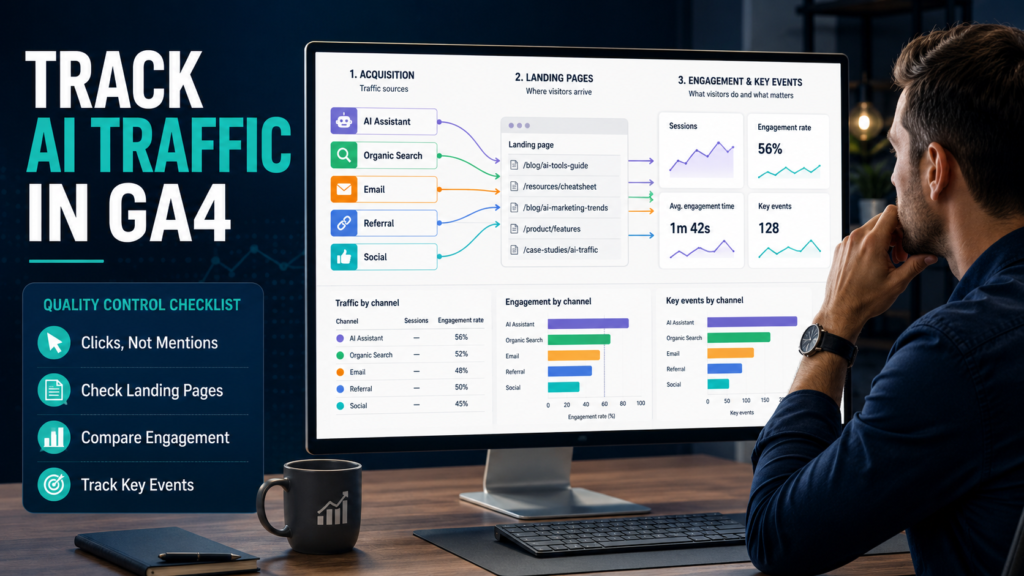
Website owners have been asking a new analytics question:
Is ChatGPT, Gemini, Claude, or another AI assistant sending people to my website?
Google Analytics 4 now provides a clearer answer than it did previously.
On May 13, 2026, Google announced dedicated AI Assistant traffic measurement. For recognized AI-assistant referrals, GA4 can assign an ai-assistant medium, categorize visits under an AI Assistant default channel, and associate them with an (ai-assistant) campaign.
That means marketers can begin comparing identifiable AI-assistant visits with:
- Organic Search.
- Referral.
- Email.
- Social.
- Other acquisition channels.
The important limitation is that GA4 measures what happens when identifiable traffic reaches your website.
It does not tell you every time an AI assistant mentioned your brand or used your information in an answer.
Key Takeaways
- GA4 introduced a dedicated AI Assistant traffic classification in May 2026.
- Recognized visits may be assigned the
ai-assistantmedium. - The new default channel is AI Assistant.
- The associated campaign value is
(ai-assistant)for qualifying traffic. - Traffic Acquisition is the main starting report for evaluating session sources.
- AI referral sessions are not the same as AI mentions.
- Track landing pages, engagement, and key events rather than sessions alone.
- Build a baseline now even if current AI traffic is small.
What Changed in GA4?
Previously, traffic from AI assistants could appear within referral data or require custom analysis.
Google’s May 2026 Analytics update created a dedicated classification for recognized AI-assistant referrals.
The update added three useful pieces of information:
Medium
ai-assistant
Channel Group
AI Assistant
Campaign
(ai-assistant)
This gives website owners a more standardized view of qualifying AI traffic.
What Does “Recognized” Mean?
Google’s default-channel criteria depend on referral information matching sources it recognizes as AI assistants.
That distinction matters.
GA4 is not reading a ChatGPT conversation and telling you:
“Your business was mentioned seven times today.”
It is analyzing website-session acquisition data.
Someone must reach your site with enough referral information for Analytics to classify the visit.
AI Mentions and AI Traffic Are Different
Imagine:
Scenario A
A person asks an AI assistant for:
“Good beginner guides for creating an ebook.”
The AI answer mentions your website but the user never visits.
GA4 records nothing.
Scenario B
The AI answer contains a link to your article.
The user clicks it.
If GA4 recognizes the referral source, that visit may be categorized as AI Assistant.
Scenario C
The person sees your brand in an AI response, closes the app, and types your domain into a browser later.
That later session may not preserve AI-referral information.
This last point is an inference from how GA4 relies on traffic-source and referrer information: Google notes generally that when traffic-source information is missing, visits can fall into Direct or otherwise lose attribution context.
So AI Assistant reporting is useful, but it is not a complete measure of AI influence.
Where to Look
Open GA4.
Go to:
Reports → Acquisition → Traffic acquisition
Google describes the Traffic Acquisition report as the report designed to show where website and app sessions are coming from.
Depending on your report configuration, review:
- Session default channel group.
- Session source / medium.
- Session campaign.
Look for:
AI Assistant
Compare AI Assistant With Organic Search
A useful first comparison is:
- AI Assistant.
- Organic Search.
Review:
- Sessions.
- Engaged sessions.
- Engagement rate.
- Average engagement time.
- Key events.
- Revenue when applicable.
Do not assume one channel is “better” because it sends more sessions.
A small amount of highly relevant AI traffic may still be useful.
Find the Actual AI Sources
The AI Assistant channel groups qualifying traffic.
To investigate more deeply, review source / medium.
This may help distinguish recognized sources rather than treating all AI traffic as identical.
The exact source values you see depend on actual traffic and Google’s classification.
Do not create fake source rows for platforms that have not sent visits.
Track Landing Pages
One of the most useful questions is:
Which pages do AI assistants send visitors to?
Possible examples:
- Detailed tutorial.
- Software review.
- Comparison.
- Product guide.
- Original research.
- Homepage.
If AI visitors repeatedly land on one article, study why that page might be useful.
Does it contain:
- Clear answer?
- Distinctive framework?
- Current product facts?
- Original checklist?
- Detailed comparison?
Do not immediately rewrite it.
Learn from it.
Connect Landing Pages With Search Intent
Suppose AI Assistant traffic lands on:
GetResponse vs. AWeber for Beginners
That visitor is probably in a different decision stage from someone landing on:
What Is Email Marketing?
Compare behavior accordingly.
One may be:
- Early research.
The other:
- Product comparison.
Different pages can have different business value.
Define Meaningful Key Events
Sessions alone are not enough.
Useful business actions may include:
- Email signup.
- Lead-magnet download.
- Contact submission.
- Purchase.
- Course enrollment.
- Account creation.
Mark only genuinely important actions as key events according to your GA4 setup.
Then ask:
Do AI Assistant visitors complete those actions?
Build a Baseline Report
Record monthly:
AI Assistant Sessions:
Top Sources:
Top Landing Pages:
Engagement Rate:
Average Engagement Time:
Key Events:
Purchases or Revenue: when relevant
Comparison With Organic Search:
Notes:
The goal during the first months may simply be establishing a baseline.
Do Not Panic if the Number Is Small
AI Assistant traffic is a relatively new identifiable channel.
Your site may receive:
- None.
- A handful of sessions.
- A meaningful number.
Small volume does not automatically mean your site is invisible in AI answers.
Remember:
GA4 is measuring identifiable visits, not total mentions.
Do Not Confuse Google AI Search With External AI Assistants
An important analytics distinction is where the click originates.
Traffic from Google Search—including its AI-driven search experiences—may still be classified through Search-related channels rather than as an external AI Assistant referral.
The dedicated AI Assistant classification is based on recognized assistant referral criteria.
Therefore, do not interpret the AI Assistant row as:
“All AI-influenced traffic everywhere.”
It is more specific than that.
Compare Quality, Not Just Quantity
Suppose:
Organic Search
2,000 sessions.
20 email signups.
AI Assistant
100 sessions.
8 email signups.
The AI channel is much smaller but may represent stronger intent.
That does not prove AI traffic is universally better.
It gives you a reason to investigate.
Use your actual numbers.
Look at Page Paths After Arrival
What do AI visitors do next?
Potential paths:
Article → About page
Review → Affiliate link
Guide → Lead magnet
Comparison → Pricing page
This can reveal whether the entry page provides a logical next step.
Improve the Destination Before Chasing “AI SEO”
If an AI assistant sends someone to your page, the visitor still needs:
- Clear headline.
- Direct answer.
- Accurate information.
- Useful next step.
- Mobile readability.
- Trust.
Do not let the new traffic label distract you from normal website quality.
The visitor is still a person.
Do Not Add Fake AI Optimization Tricks
Avoid strategies such as:
- Stuffing “ChatGPT” into unrelated headings.
- Publishing hundreds of near-duplicate answer pages.
- Claiming “AI optimized” without meaning.
- Adding fake citations.
- Creating content solely to manipulate assistant answers.
Measure what is already happening.
Then improve useful content.
Use Search Console Alongside GA4
Search Console explains performance from Google Search.
GA4 explains on-site behavior across acquisition channels.
Use them together.
For example:
Search Console
Which Google queries bring visitors?
GA4
What do Organic Search and AI Assistant visitors do after arrival?
This produces a broader discovery picture.
Create an AI Traffic Review Every Month
Step 1
Open Traffic Acquisition.
Step 2
Find AI Assistant.
Step 3
Record sessions.
Step 4
Inspect source / medium.
Step 5
Identify top landing pages.
Step 6
Review engagement.
Step 7
Review key events.
Step 8
Compare with Organic Search and Referral.
Step 9
Record meaningful changes.
Step 10
Decide whether any page needs improvement.
Do not create a complicated dashboard until the data justifies one.
Practical Example
Imagine a marketing website receives 75 AI Assistant sessions during August.
Forty land on:
How to Create a Lead Magnet With AI
Twenty land on:
ClickDesigns Review
Fifteen land on several other pages.
The useful questions are:
- Which AI source sent them?
- Why are those two pages being selected?
- Do visitors engage?
- Do they join the list?
- Does the review receive affiliate clicks?
- Are those pages accurate and current?
Those questions are more useful than:
“How do I make the AI traffic number bigger?”
Common AI-Traffic Measurement Mistakes
Treating AI Assistant as all AI visibility
It measures identifiable traffic, not every mention.
Looking only at sessions
Review engagement and key events.
Ignoring landing pages
Find what content receives the visits.
Assuming Direct contains no AI-influenced users
Missing referral information can limit attribution.
Creating complicated custom tracking immediately
Use Google’s new default classification first.
Making claims from tiny samples
Build a baseline over time.
Conclusion
Google Analytics 4 now gives marketers a dedicated way to examine qualifying traffic from recognized AI assistants.
The May 2026 update introduced the AI Assistant channel, ai-assistant medium, and (ai-assistant) campaign classification for recognized referrals.
That is an important improvement.
It still does not measure every AI mention or every AI-influenced customer journey.
Use the new channel for what it actually provides: evidence about identifiable AI-assistant visitors who reach your website.
Open Traffic Acquisition, record your current AI Assistant baseline, and identify the first landing pages those visitors are reaching.